Description
A spring-loaded relief valve holds a disc against a seat with a calibrated spring. When inlet pressure reaches the set pressure the disc lifts and the valve discharges; when pressure falls back the spring reseats it. It is the last line of defence on a vessel, receiver, pump discharge or heat exchanger, and its set pressure is chosen from the protected equipment's design pressure, not from the pipe size.
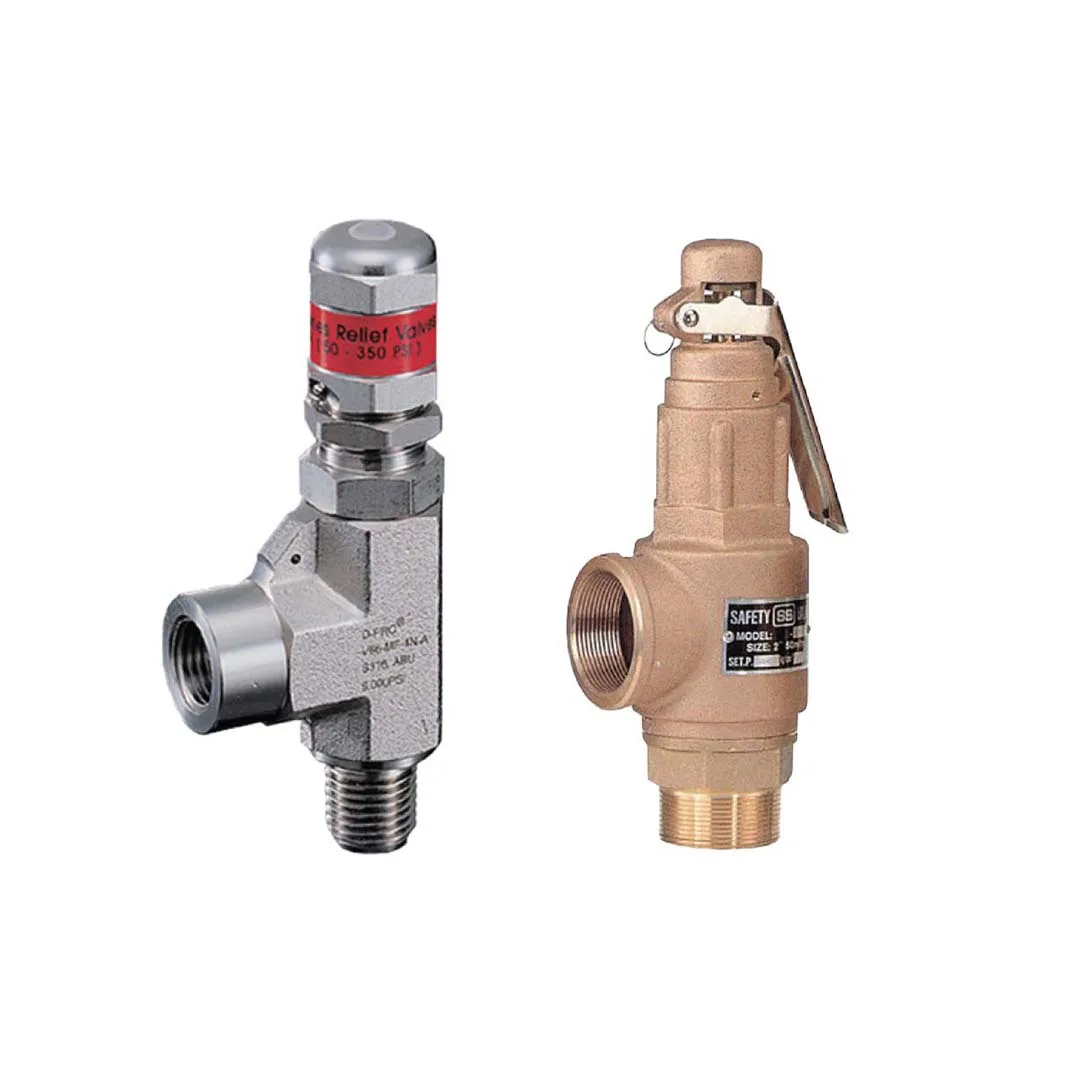
Two patterns are shown. The stainless steel valve is an angle pattern with a male inlet below and a female outlet at the side, closed by a cap, for instrument and small process lines; the band around its bonnet gives the spring range as 50 - 350 psi. The bronze valve is a full-lift safety valve with an open test lever, the pattern normally used on air receivers, boilers and steam and water services, where the lever allows a manual proof lift without shutting the plant down. Its nameplate carries MODEL, SIZE and SET.P. fields, so the set pressure is fixed and stamped per unit at the factory.
When ordering, state the set pressure, the inlet and outlet sizes and thread forms, the body material, the service fluid and temperature, the required discharge capacity, and whether a lifting lever, a sealed cap or a test certificate is needed. A valve should never be selected on connection size alone: two valves with the same inlet thread can have very different discharge capacities.