Butterfly Valve Lug Type

Lug Type Butterfly Valve, Stainless Steel Disc

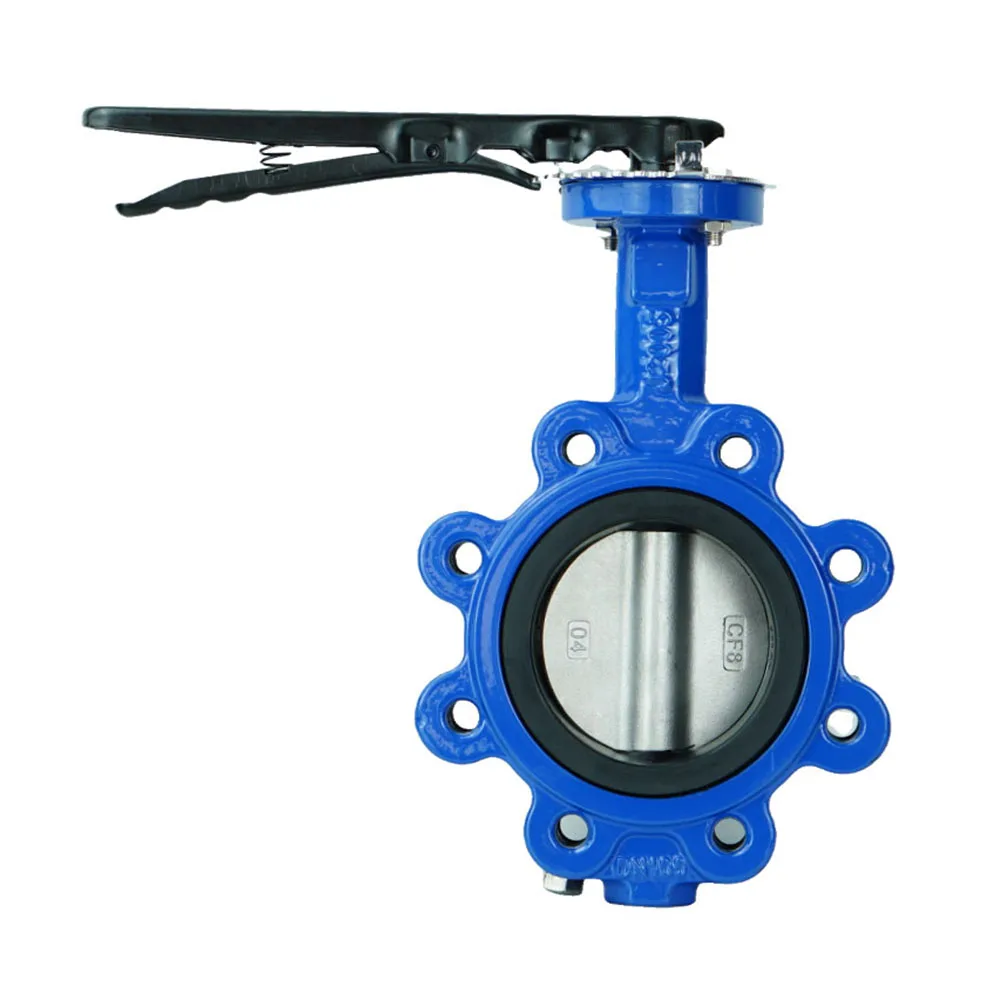
Resilient-seated lug type butterfly valve with an ASTM A351 CF8 stainless disc and a lever operator. The tapped lugs take bolts from each flange independently, so one side of the line can be dismantled with the valve closed.

Prices on request. Contact us for availability and quotations.

Description

A lug type butterfly valve carries tapped lugs around the body. Each companion flange bolts into the lugs from its own side rather than through the valve, so the valve is a fixed point in the line and either side of the pipework can be taken apart while the valve holds pressure. That is the whole difference from the wafer body, and it is the reason lug valves are used at the end of a header, at a pump take-off, or anywhere a spool has to come out for maintenance.

The permission to do that is not automatic. API 609 states that lug-type valves "with no interruptions of the gasket seating surface may be suitable for dead-end service only when installed with the seat retainer plate on the pressure side", and that valves not designed for dead-end service "shall be marked Not for Dead-End Service". Read the body marking before relying on a lug valve to hold an open flange, and note the differential pressure the maker has marked on it.

The disc in the photograph is cast with "CF8", the austenitic casting grade of ASTM A351 that corresponds to wrought type 304. It is a good general-service disc in water, air and mild chemicals; where chlorides are present, CF8M - the cast equivalent of 316 - is the grade to ask for. The seat is a resilient elastomer liner that also serves as the flange gasket, and its grade decides fluid compatibility.

When ordering, state the nominal size, the flange standard the lugs are tapped for, the disc and seat materials, the operator, and whether dead-end service is required. Confirm the working pressure with the supplier - no rating is marked on the valve in the photograph.
Specifications

Body Style Single flange (lug): tapped lugs around the body take the bolts of each companion flange independently, so either side of the line can be dismantled with the valve in place
Disc Material ASTM A351 CF8 cast austenitic stainless steel, the cast grade corresponding to wrought type 304
Dead-End Service Not automatic. API 609: lug-type valves with no interruptions of the gasket seating surface "may be suitable for dead-end service only when installed with the seat retainer plate on the pressure side"; valves not designed for it "shall be marked Not for Dead-End Service". Read the body marking
Flange Compatibility (lug ends, MSS SP-67) Lug ends to MSS SP-67 are compatible with flanges to ASME B16.1 Class 25 or 125, ASME B16.5 Class 150, ASME B16.24 Class 150, ASME B16.42 Class 150, or AWWA C207
Seat Resilient elastomer liner covering the body bore and both body faces, doubling as the flange gasket. The elastomer grade must be specified
Operator Lever with a notched locking plate
Face-to-Face API 609 Category A lug- and wafer-type, metal-to-metal across body flats: 43 mm at NPS 2, 46 mm at NPS 2.1/2 and NPS 3, 52 mm at NPS 4, 56 mm at NPS 5 and 6, 60 mm at NPS 8, 68 mm at NPS 10, 78 mm at NPS 12 and 14, 102 mm at NPS 16, 114 mm at NPS 18, 127 mm at NPS 20, 154 mm at NPS 24, rising to 276 mm at NPS 48. Varies with size - do not quote a single figure
Flange Standard (to be specified) The drilling the valve is designed for must be stated - EN 1092-1 PN10/16 or ASME B16.5 Class 150. The two are separate systems: at DN50 / NPS 2 the EN bolt circle is 125 mm and the ASME bolt circle is 120,7 mm, with M16 bolts against 5/8 in UNC. They are not interchangeable
Product Standards (valve type) MSS SP-67 (flangeless/wafer, single-flange/lug and flanged-end butterfly valves, NPS 1.1/2 - NPS 72); EN 593 (metallic butterfly valves, wafer, lug, flange and butt-welding ends, PN 2,5 - PN 160 and Class 150 - 900, DN 20 - DN 4000); API 609 Category A (manufacturer's rated cold working pressure valves, usually concentric disc and seat, NPS 2 - NPS 48 for ASME Class 125 or 150 bolting patterns)