Description
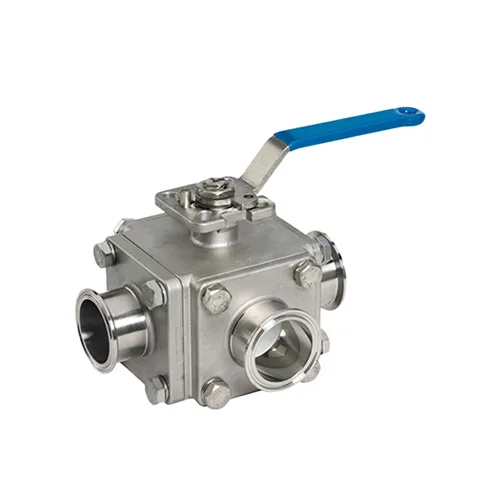
A three-way ball valve carries a drilled ball in a body with three clamp ferrule ports. The drilling decides what the valve can do: an L-port connects the inlet to one of two outlets and shuts the other, while a T-port can join two ports to the third or connect all three. The two are not interchangeable and the pattern cannot be read from the outside of an assembled valve, so it has to be stated on the order.
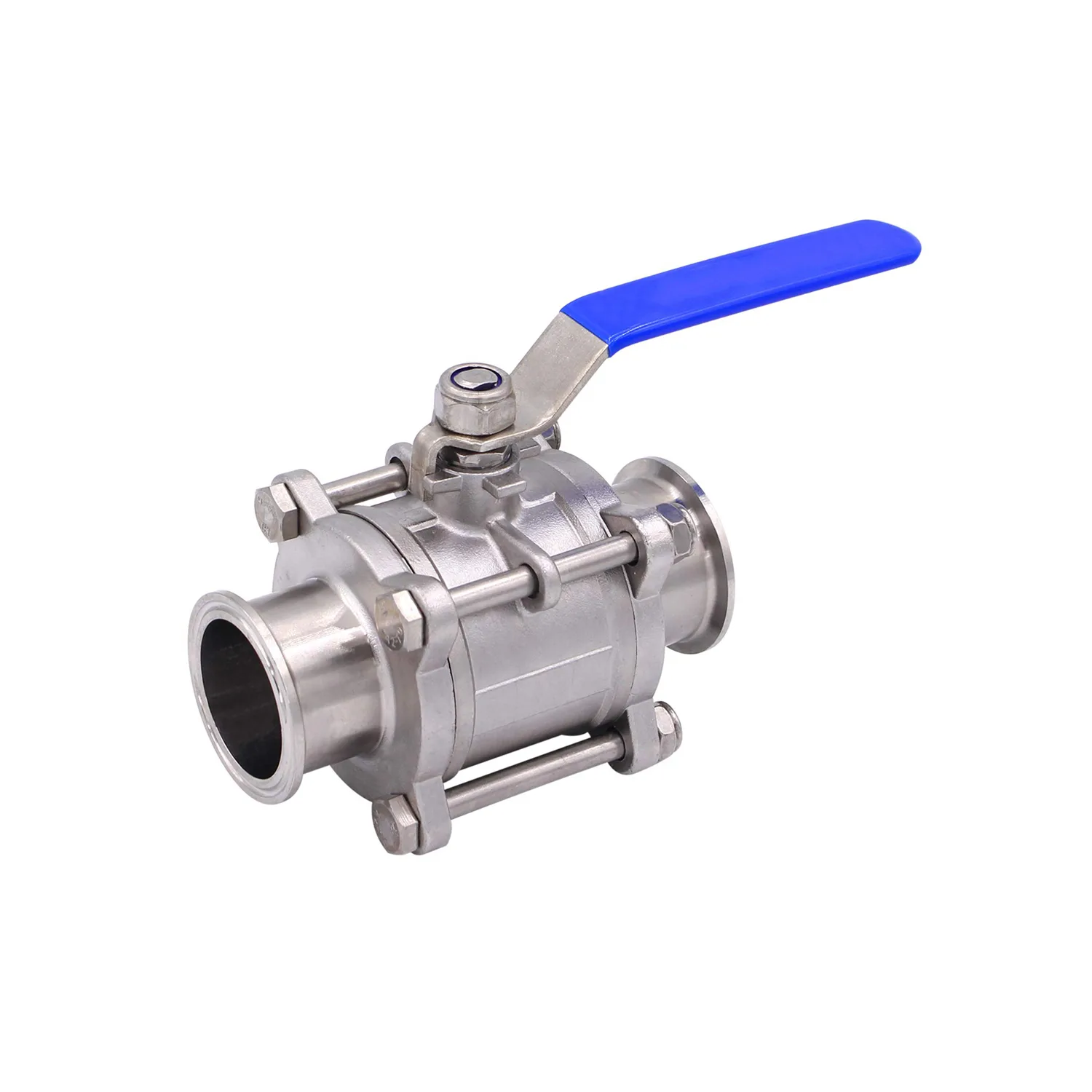
The ports are clamp ferrules to DIN 32676 Series A, B or C, or to the withdrawn ISO 2852. Because the clamp ring and gasket are sized on the flange diameter rather than the bore, ferrules for 25 mm, 33.7 mm and 38 mm tube share the 50.5 mm clamp and gasket. Permissible pressure follows the connection and falls with size: 25 bar for tube up to 42.4 mm outside diameter, 16 bar to 76.1 mm and 10 bar to 219.1 mm, between −10 °C and +140 °C with suitable clamps and seals.
Wetted parts are austenitic stainless steel to ISO 2604-1 as ISO 2852 requires, normally AISI 316L (1.4404), with a product-contact surface below Ra 1.0 µm. Seats are usually PTFE, which sets the temperature limit and is the part that wears. Gaskets are rubber of 75-85 IRHD chosen for compatibility with the product and the cleaning regime.
Specify the size and the clamp series, the port pattern, whether the handle is to be two-position or three-position, the body grade, and the seat and gasket materials. This is an on/off valve; it is not intended to modulate flow.