Description
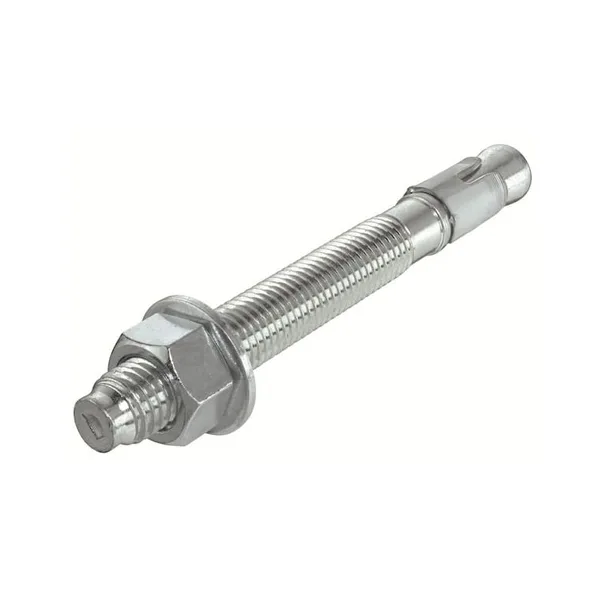
This is a post-installed mechanical anchor of the wedge or through-bolt type, not a cast-in anchor bolt. The bolt is placed in a hole drilled to the anchor diameter, and tightening the nut draws the tapered cone at the embedded end into an expansion clip, which is pressed hard against the wall of the hole. The holding capacity comes from that friction and from the strength of the surrounding concrete.
There is no generic dimensional standard that gives an anchor of this type a load rating. In Europe such anchors are assessed product by product against EOTA assessment document EAD 330232-00-0601, Mechanical fasteners for use in concrete, and the result is a European Technical Assessment issued for that specific anchor. The assessment covers behaviour in cracked as well as uncracked concrete, installation with reduced torque and in oversized holes, sustained load and load cycling. A load figure therefore belongs to a particular approved anchor and cannot be read across from another maker's product.
Anchor performance also depends on things fixed on site: hole diameter and depth, cleaning of the hole, embedment depth, edge distance and spacing between anchors, the concrete strength class, and the installation torque. All of these come from the approval document of the anchor actually supplied.
When ordering, state the thread diameter and total length, the thickness of the item being fixed, the base material (concrete, hollow block or masonry - a wedge anchor is for solid concrete), and the finish required, zinc-plated steel or stainless. Ask for the manufacturer's approval document and installation data with the anchor, and do not assign a working load without it.