Description
A jaw coupling is made of two hubs whose cams interleave, with an elastomer spider between them. Torque passes from one hub through the spider cams to the other, so the elastomer teeth are loaded in compression only rather than in bending. That is what gives the design its load capacity and its tolerance of parallel, angular and axial misalignment.
Polyurethane is the usual spider material where torque density matters, because it carries a higher load than nitrile at the same size and resists abrasion well. KTR, which originated the ROTEX jaw coupling, publishes three polyurethane hardness grades for its spiders: 92 Shore A, 98 Shore A and 64 Shore D. Harder elements give higher torsional stiffness and less damping; softer elements damp more and are more forgiving of misalignment.
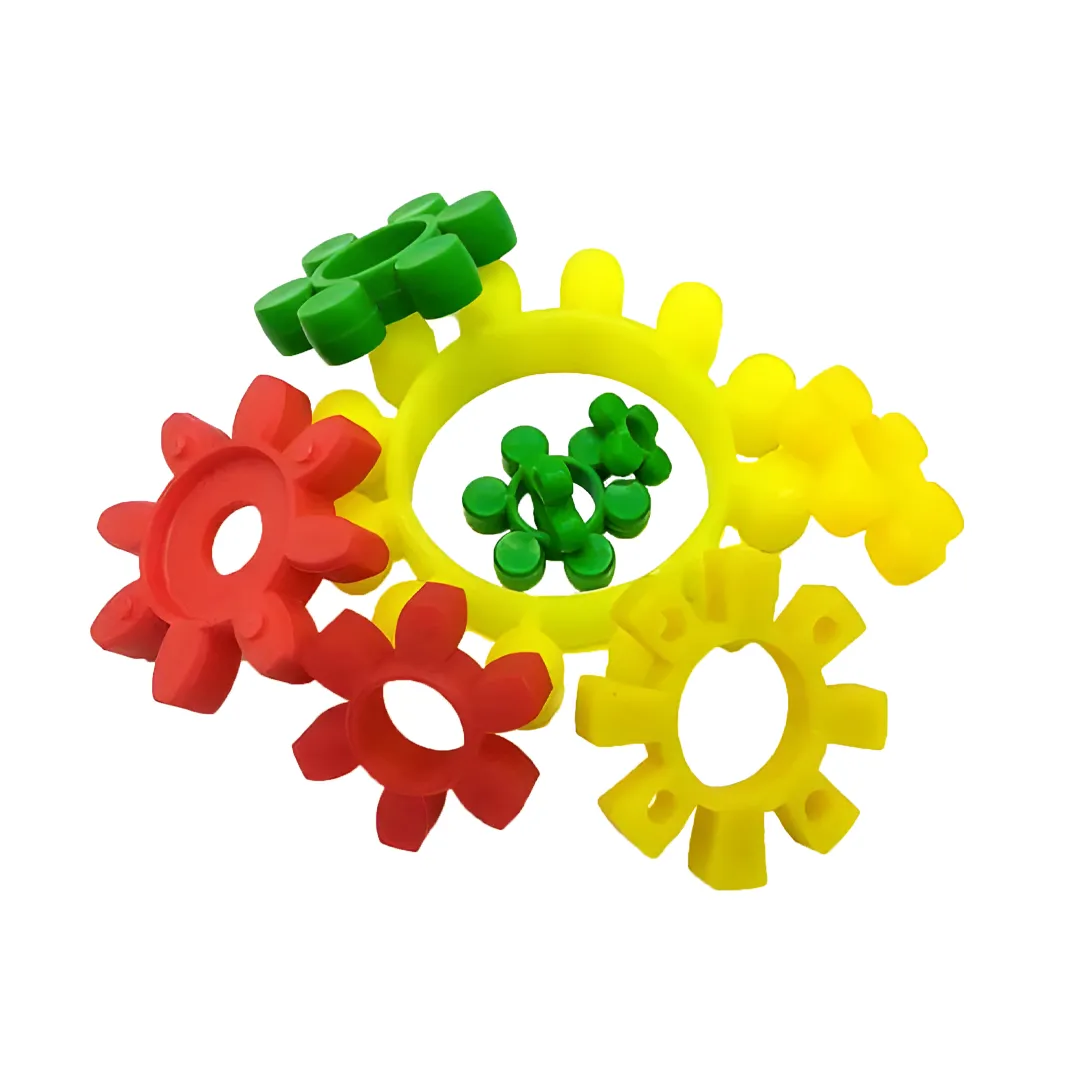
Colour is not a reliable indication of hardness on unbranded product. KTR marks its own T-PUR elastomer orange for 92 Shore A, purple for 98 Shore A and light green for 64 Shore D, but that is KTR's convention and generic makers use their own. The spiders in the product photograph are yellow, red and green, which is not KTR's scheme. Confirm the hardness against the part or the supplier rather than by colour.
The name carried in the older catalogue, 'Spider Jaw Coupling Washer', is misleading: the part is a coupling element, not a washer. When ordering, state the coupling size, the number of cams on the spider, the hardness, and whether the open star or the closed outer-ring form is required, since these must match the hubs already fitted.