Description
A ring type joint gasket is a machined metal ring that seats in a matching groove cut into each flange face. Bolt load forces the ring to deform plastically against the groove flanks, producing a narrow, very high contact stress that seals without relying on an elastomer or a soft filler. This is the sealing method used on high-pressure and high-temperature hydrocarbon service and on wellhead equipment.
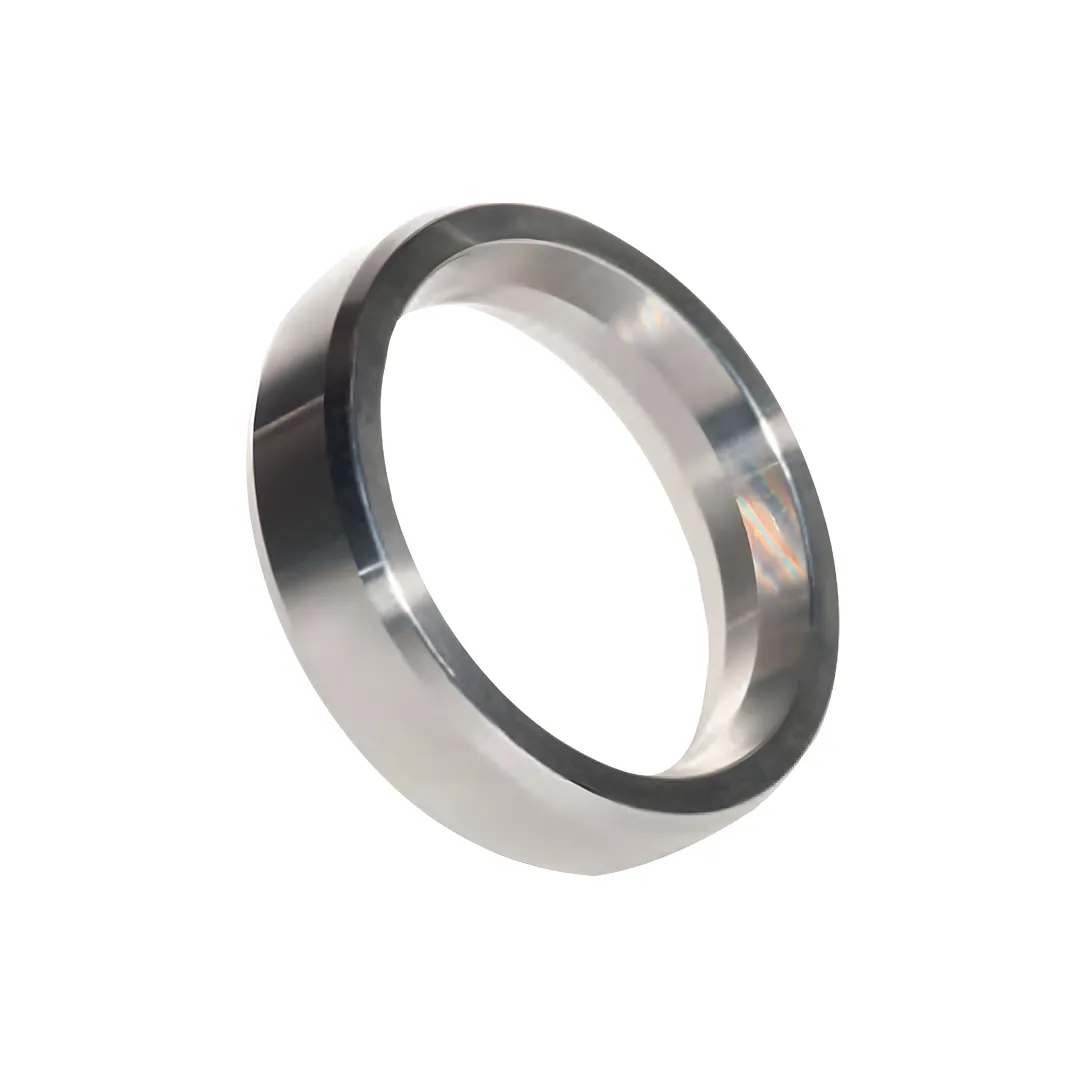
ASME B16.20-2007 covers the materials, dimensions, tolerances and markings. Ring joint gaskets are either octagonal or oval in cross section; the octagonal section seals better and is the usual choice, and the gasket photographed here is octagonal. Rings are identified by an R, RX or BX number that relates to the flange size, the pressure class and the flange standard. Type R runs from R-11 to R-105, type RX from RX-20 to RX-215 and type BX from BX-150 to BX-303. Type R is tabulated for ASME B16.5, ASME B16.47 Series A and API 6B flanges, type RX for API 6B flanges, and type BX for API 6BX equipment, where it is the pressure-energised style.
Material selection turns on one recommendation above all others: ASME B16.20 recommends that the ring be of lesser hardness than the mating flange, so that the ring deforms and the flange does not. ASME B16.20 Table 1 caps the hardness at 90 HB for soft iron, 120 HB for low-carbon steel, 130 HB for 4-6 chrome half-moly, 170 HB for Type 410 and 160 HB for Types 304, 316 and 347. The standard also fixes the surface finish: no rougher than 1,6 micrometres for R and RX rings and 0,8 micrometres for BX.
A conforming ring carries the manufacturer's name or trademark, the R, RX or BX number, the material identification letter and the ASME B16.20 designation on its outer surface. When ordering, state the flange standard, nominal size and pressure class, or the ring number itself, together with the ring material and the flange groove material and hardness.