Description
A push-in fitting joins plastic tube to a threaded port or to another length of tube without tools. Inside the body a collet carries a ring of hardened stainless steel teeth angled inwards; pushing the tube in lets it pass the teeth, and any attempt to pull it back drives the teeth harder into the tube wall. Sealing is separate from gripping - an O-ring bears on the outside diameter of the tube - which is why the tube must be cut square and left unscratched. Pressing the collet ring towards the body lifts the teeth clear and releases the tube for reuse.
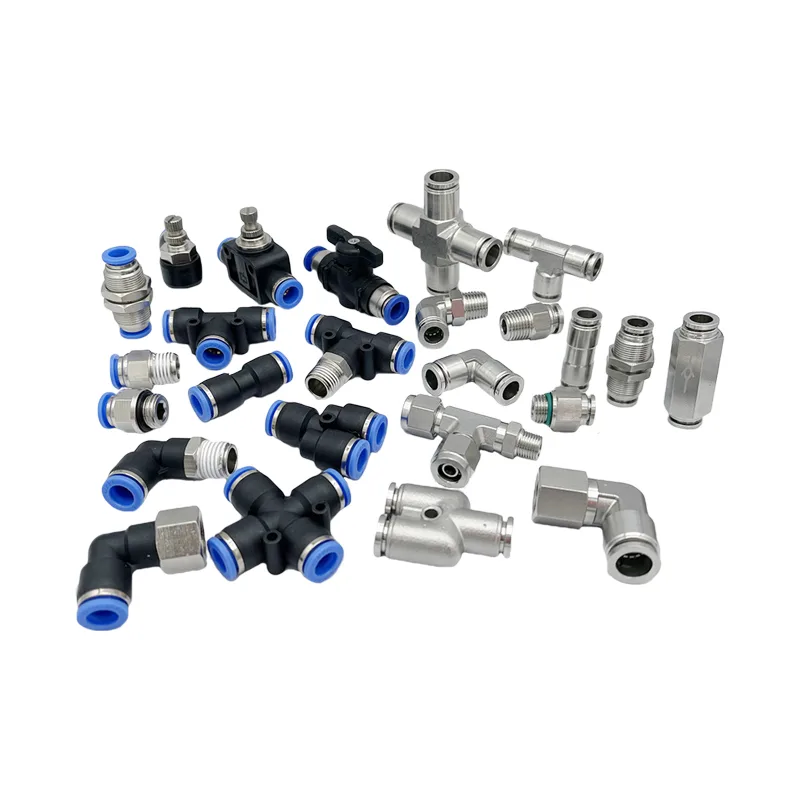
The range covers straight tube-to-thread and tube-to-tube unions, 90 degree elbows fixed and swivel, tees in run and branch forms, crosses, banjo fittings for tight cylinder ports, bulkhead fittings, and in-line variants with an integral flow regulator or a small isolating ball valve. The photograph shows both composite-bodied fittings with plated brass threads and all-metal fittings in plated brass and stainless steel.
Push-in connectors of this kind are covered by ISO 14743, which fixes the tube outside diameters they are made for, the connector dimensions, the thread and stud-end form for each thread type, and the tensile, pressure and leakage tests a connector assembly has to pass. What it does not do is make commodity fittings interchangeable in practice: conformity is not marked on them, nothing guarantees that one maker's collet will hold another maker's tube to the same rating, and mixing brands within a circuit is a common cause of slow leaks. The tube outside diameter and the thread form are the ordering data, and they are what must be matched.
When ordering, state the tube outside diameter, the thread size and form - BSPP, BSPT, NPT or metric - the body style, and the body material. Thread form matters more than thread size: a BSPP male will screw into a BSPT female and leak, because one seals on a face or washer and the other on the taper. Confirm also whether the port needs a pre-applied thread sealant or a bonded seal.