Description
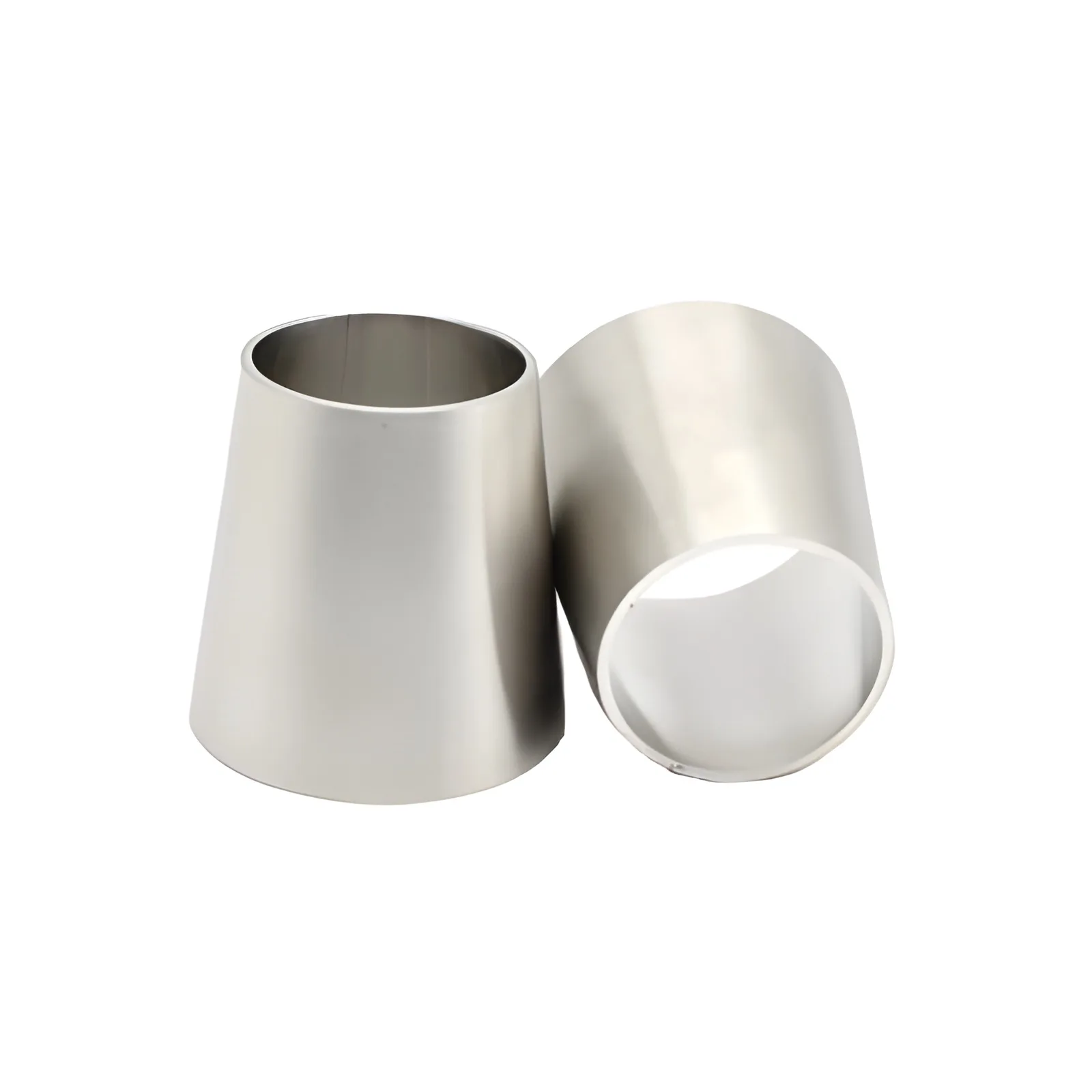
A reducer joins two tube sizes with a smooth conical transition, so the bore steps down without a shoulder that would trap product or disturb the flow. Like the other hygienic tubular fittings it is formed from tube and the internal finish carries through.
DIN 11852 distinguishes the concentric reducer, RK, from the eccentric, RE, and the choice is a process decision rather than a preference. A concentric reducer is symmetrical about the axis and is correct on a vertical line. On a horizontal line it leaves a pocket at the bottom of the cone that will not drain; the eccentric reducer, fitted flat side down, keeps the invert continuous so the line drains fully. Note also that on a reducer the DN size refers to the largest diameter.
Material is austenitic stainless steel, in practice 316L (1.4404) for wetted service, with the internal surface specified as an Ra value. Both ends are plain for butt welding, so the tube standard at each end must be given — a reducer between two different systems, say EN 10357-A on one end and ASME BPE on the other, is a special and has to be identified as one.
State both sizes and the tube standard at each end, the pattern — concentric or eccentric — the grade, the internal Ra and the surface condition, and ask for the EN 10204 3.1 certificate at the order stage.