Description
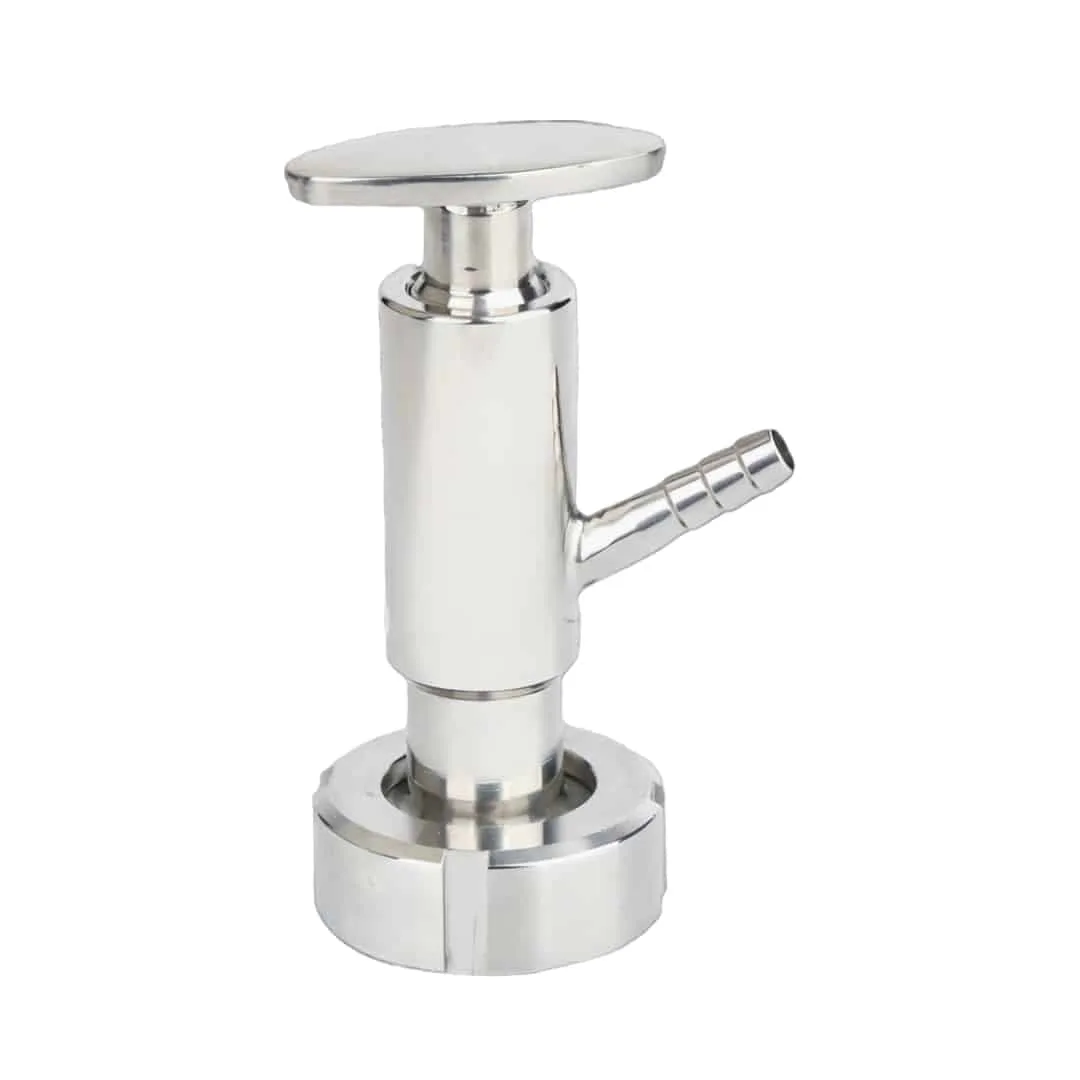
The valve is a plunger cock. Pressing the head lifts the plunger off its seat and opens a short, straight path from the process to the outlet; releasing it lets the spring close the valve. The dead volume is deliberately small so that the sample represents the bulk of the product and not what has been standing in the valve since the last draw. The outlet is a hose barb, which lets a short length of sample tubing be run into a bottle or a jar.
All three sampling valves in this catalogue are the same valve; they differ only in how they mount to the vessel or the line. The process connection on this one is a union nut, SMS 1145 or DIN 11851. Choose the mounting to suit the vessel: a threaded boss on a tank wall, a clamp ferrule on a hygienic line, or a union nut where the point is stripped down for cleaning.
Wetted parts are austenitic stainless steel, in practice AISI 316L (1.4404), with the product-contact surface finished to the hygienic norm of Ra 0.8 µm or better. The seal is chosen for the product and the sterilising regime; where the sample point is flamed or steamed between draws, say so, because that rules out several elastomers.
State the process connection and its size, the outlet form and hose bore, the body grade, the seal material, and whether steam sterilisation of the sample point is required. Sample-point technique matters as much as the valve: purge the dead leg before drawing, and keep the outlet covered between draws.