Description
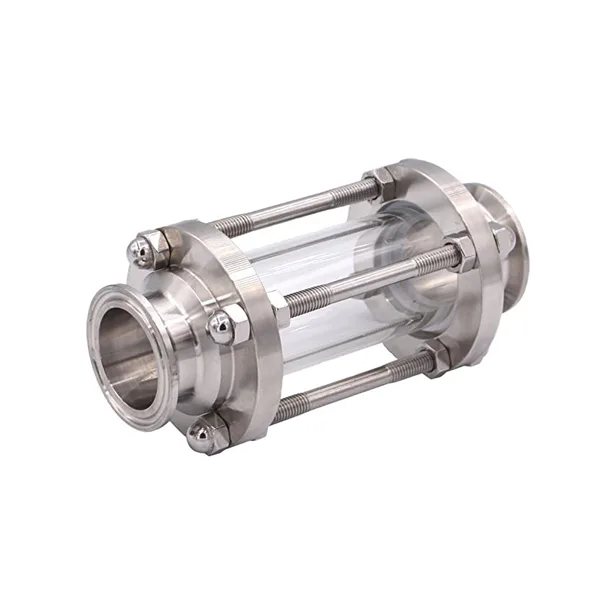
A tubular sight glass puts a full-bore glass cylinder into the line so that the whole cross-section is visible. Two stainless end pieces are drawn together onto the glass by external tie rods with domed nuts, with a gasket at each end taking up the difference in expansion between glass and steel. Because the bore is unobstructed the sight glass drains and cleans in place with the rest of the line.
The type matters more than any other detail on this item. A tubular sight glass is rated far lower than a window or union type, and its rating collapses as the size rises — a published range for this pattern runs 10 bar at DN25 to 3 bar at DN150, whereas a window-type sight glass of the screwed union pattern holds up to 10 barg across its whole range. Quoting a window figure for a tubular item would overstate a DN150 rating by more than three times.
The glass is borosilicate, specified to ISO 3585 and ASTM E438 Type I Class A for the tubular pattern or to DIN 7080 for a window disc. Metal parts are austenitic stainless steel, in practice AISI 316L (1.4404) for the wetted end pieces, with a product-contact finish of Ra 0.8 µm or better. Gaskets are chosen for the product and the cleaning regime.
State the type — tubular or window — the size and the connection, the gasket material, the glass standard, and whether a glass guard is required; a protective cage is normal where the line can be struck. Do not shock the glass thermally: a cold CIP rinse straight onto hot glass, or the reverse, is the usual cause of failure.