Description
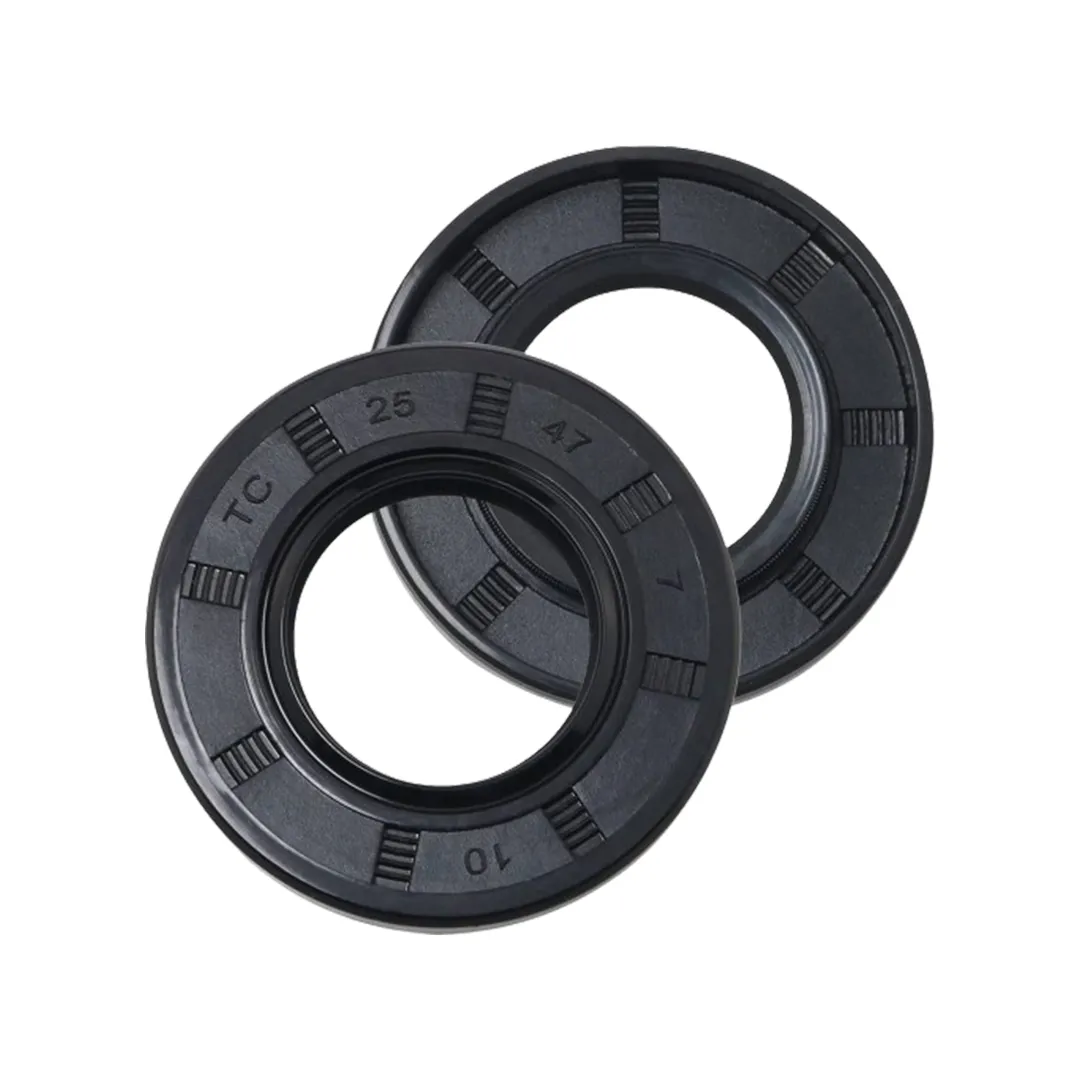
A radial shaft seal works by holding a thin flexible lip against the rotating shaft with a light, evenly distributed radial force. In the TC profile that force comes from a garter spring seated behind the main lip, and a second lip without a spring faces outboard to exclude dust and splash. The metal case is fully covered in rubber, so the seal also seals statically against the housing bore - which matters in aluminium housings and anywhere thermal expansion opens the bore.
ISO 6194-1:2007 is the dimensional standard behind these seals and it defines four case constructions; the TC corresponds to its type 4, rubber-covered metal-cased, with the single-lip-plus-protection-lip arrangement of its Figure 2b. Nominal dimensions run from 6 mm to 480 mm shaft diameter and 16 mm to 530 mm housing bore. The seal photographed here is marked TC 25 47 10, and 25 x 47 is a nominal size in the standard's Table 1; the nominal width there is 7 mm, and the table's own footnote permits the width to be increased to accommodate more complex seal configurations, which is what the double-lip TC construction does.
These are low-pressure seals. ISO 6194-1 states that seals of this type are normally used with atmospheric pressure on the air side and sealing fluid at 0 to 30 kPa - that is 0,3 bar - above atmospheric, and directs the user to the manufacturer for anything higher. Fitting a standard lip seal to a pressurised housing is a common cause of premature lip wear and leakage.
Order by shaft diameter, housing bore and width in millimetres, plus the profile letters and the elastomer. Nitrile is the general-purpose compound; fluoroelastomer is used for higher temperature and for aggressive media. The shaft counterface finish, hardness and lead-in chamfer are as important as the seal itself and are specified in the same standard.