Description
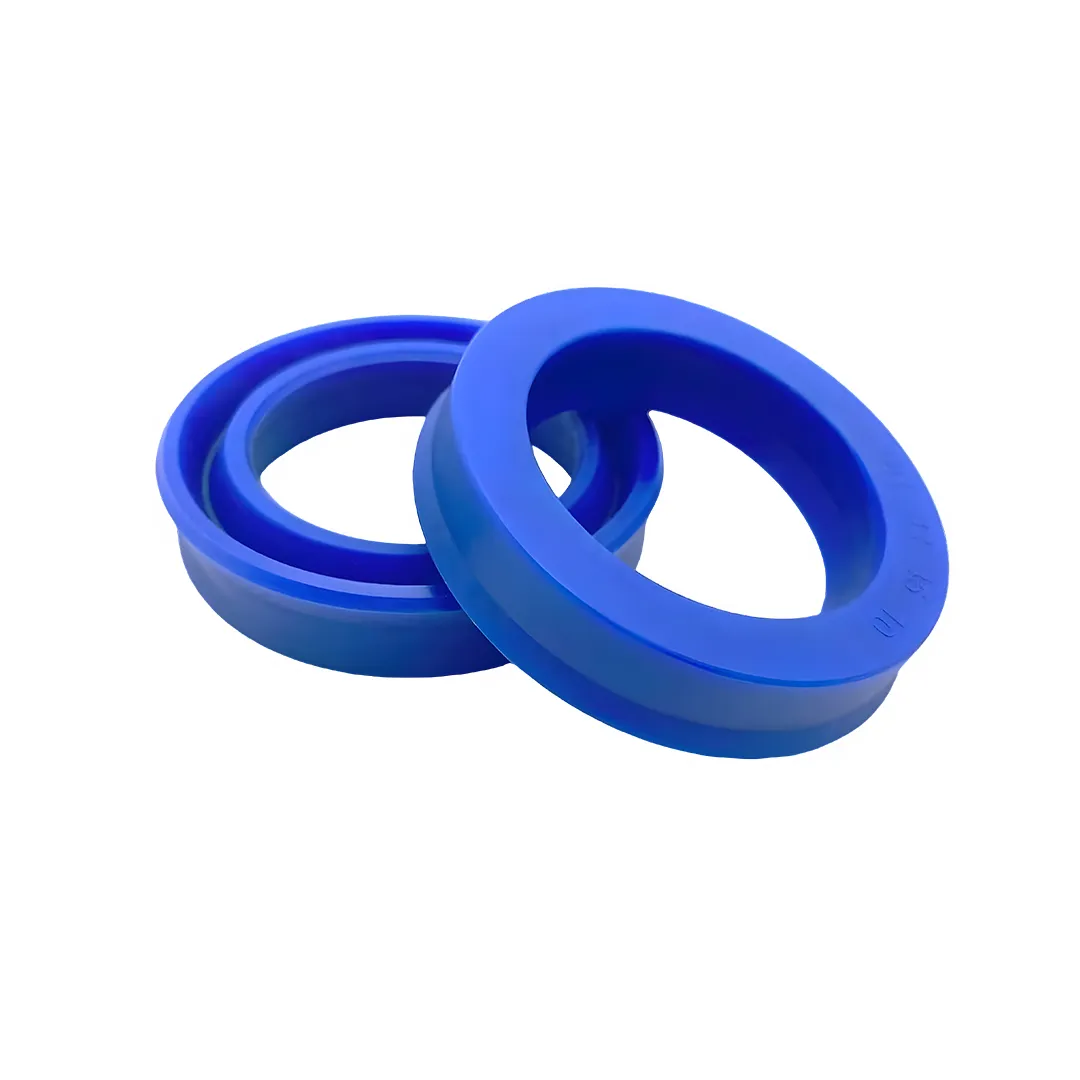
A U-cup is a single-acting seal whose cross-section opens towards the pressure. System pressure enters the cavity between the two lips and forces them apart, so contact stress rises with pressure and the seal becomes tighter as the duty gets harder. At rest the interference built into the lips maintains a light seal.
The UN profile is symmetrical: the two lips are of equal length, so one part will work as a rod seal in a gland or as a piston seal in a bore, depending on which way round it is fitted. Manufacturers publishing this profile list it as a universal piston and rod seal. That interchangeability is the main reason it is carried as a maintenance item.
Polyurethane is the standard material for this profile. It carries far higher load than a nitrile lip seal and resists abrasion and extrusion well, which is why it displaced rubber U-cups on mineral oil hydraulics. Its limitation is heat and water: Parker puts polyurethane at about +82 °C as a polymer, and in water service at only +50 °C. Colour is not evidence of compound - the seals photographed are blue, while the maker cited here supplies the same polyurethane profile in green.
Order by profile letters and d x D x H in millimetres - rod or bore diameter, outside diameter and height - together with the material. Check the extrusion gap: a U-cup working at high pressure over a large clearance will extrude at the lip heel, and a back-up ring or a tighter gap is the remedy.