Description
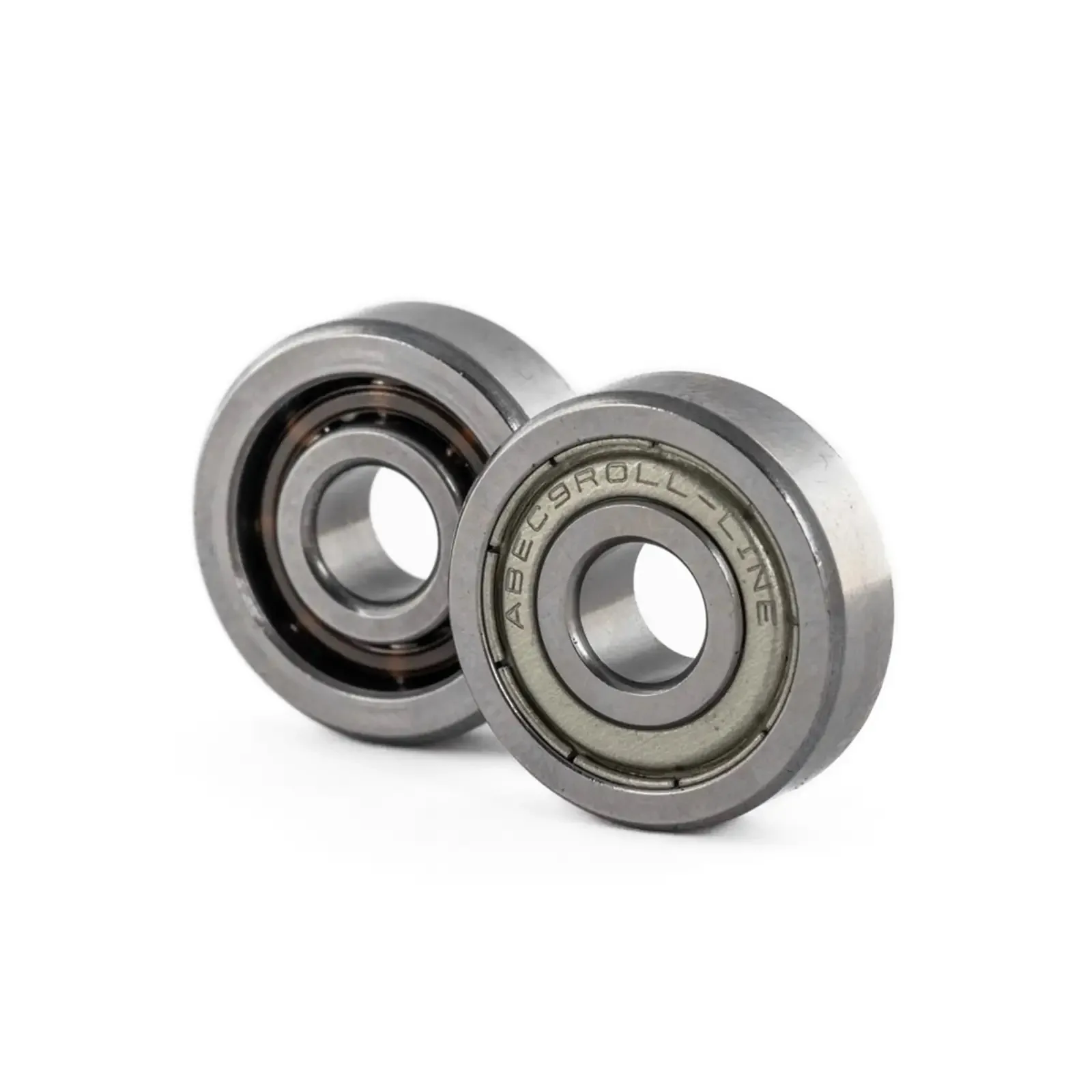
A rolling bearing carries a shaft load on balls or rollers running between hardened raceways, so that turning friction is a fraction of that of a plain bush. The general purpose type is the single row deep groove ball bearing, which takes radial load with a useful amount of axial load in either direction and runs at high speed.
Bearings are interchangeable between makers because their outside dimensions are standardised. ISO 15:2017 specifies preferred boundary dimensions for radial bearings of the diameter series 7, 8, 9, 0, 1, 2, 3 and 4 - the bore, the outside diameter and the width. A designation such as 6204 therefore denotes the same envelope wherever it is bought: the first figure is the type, the second the dimension series, and the last two the bore code. Bore codes 00, 01, 02 and 03 mean 10, 12, 15 and 17 mm; from 04 upward the bore in millimetres is the code multiplied by five, so 6204 is a 20 mm bore and 6205 a 25 mm bore.
What is not fixed by ISO 15 is everything after the number. Shield and seal suffixes - ZZ or 2Z for pressed steel shields, 2RS for contact rubber seals - internal clearance classes, cage material, precision class and lubricant are manufacturer designations and vary between catalogues. Two bearings with the same number and different suffixes are not necessarily interchangeable in service.
When ordering, give the full designation including any suffix, or give bore, outside diameter and width with the sealing arrangement, the speed and the direction of the load. State whether the bearing is a replacement for an existing machine, in which case the suffix on the old bearing matters as much as the number.