Description
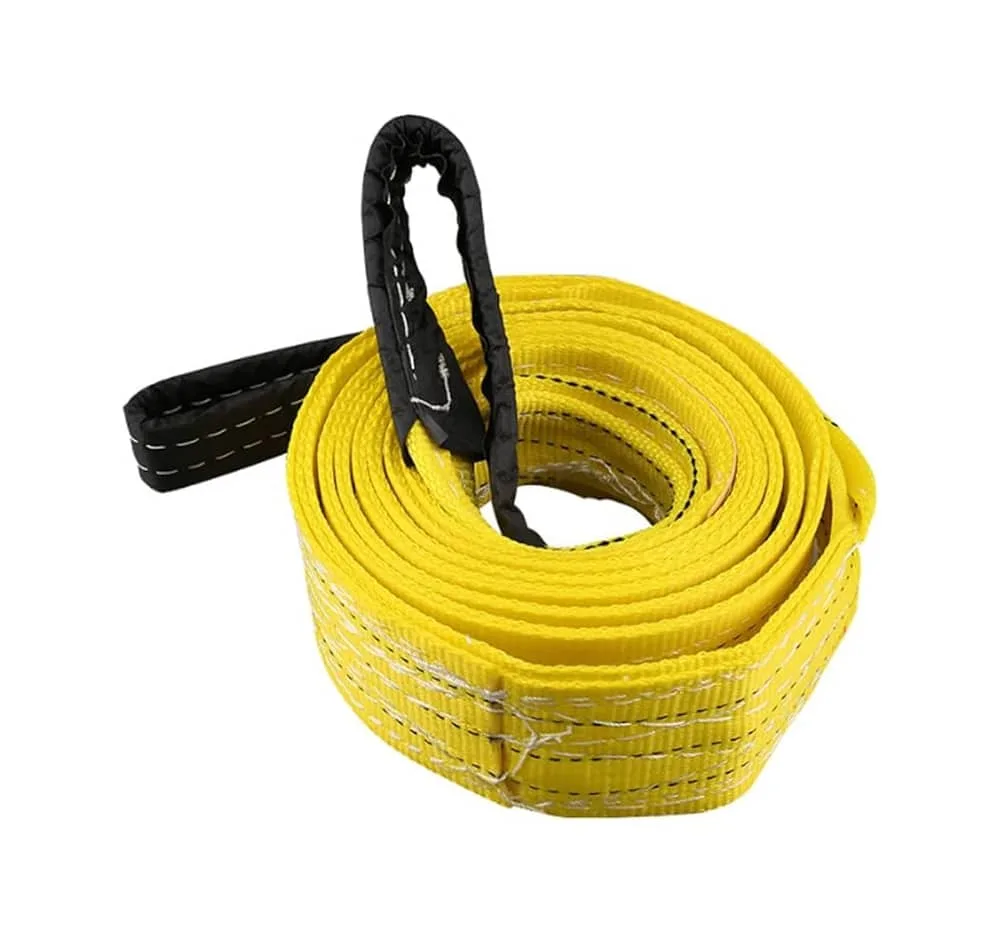
A flat webbing sling is a woven polyester belt with a reinforced eye at each end, used to take a load on a crane hook without the weight or the surface damage of a chain or a wire rope sling. It is light enough to be placed by hand, it beds onto the load rather than point-loading it, and it will not mark a painted or machined surface.
EN 1492-1 is the safety standard for flat woven webbing slings of man-made fibres for general purpose use. Slings to that standard are made with a 7:1 safety factor, so the breaking force is at least seven times the marked working load limit, and they carry a colour code that identifies capacity at a glance: purple 1 t, green 2 t, yellow 3 t, grey 4 t, red 5 t, brown 6 t, blue 8 t and orange 10 t. The sling photographed is yellow, which is the 3 t code, but the working load limit that governs is the one printed on the sling's own label.
The label is part of the product. EN 1492-1 slings must be marked with the working load limit, the standard number, the manufacturer, the sling type, the dimensions and a traceability code. A sling with an unreadable or missing label must be taken out of service - there is no way to establish its rating afterwards. High-tenacity polyester webbing works between -40 and +100 °C and resists most acids, but it is cut by sharp edges: use sleeves or corner protectors on any edge, and never knot a sling.
The marked WLL applies to a straight pull. Basket, choke and multi-leg arrangements each have their own factor, and the angle between legs reduces capacity sharply. When ordering, give the working load limit, the effective working length, the type - eye and eye as photographed, or endless - and the width, and state whether edge protection is required for the load being lifted.