Description
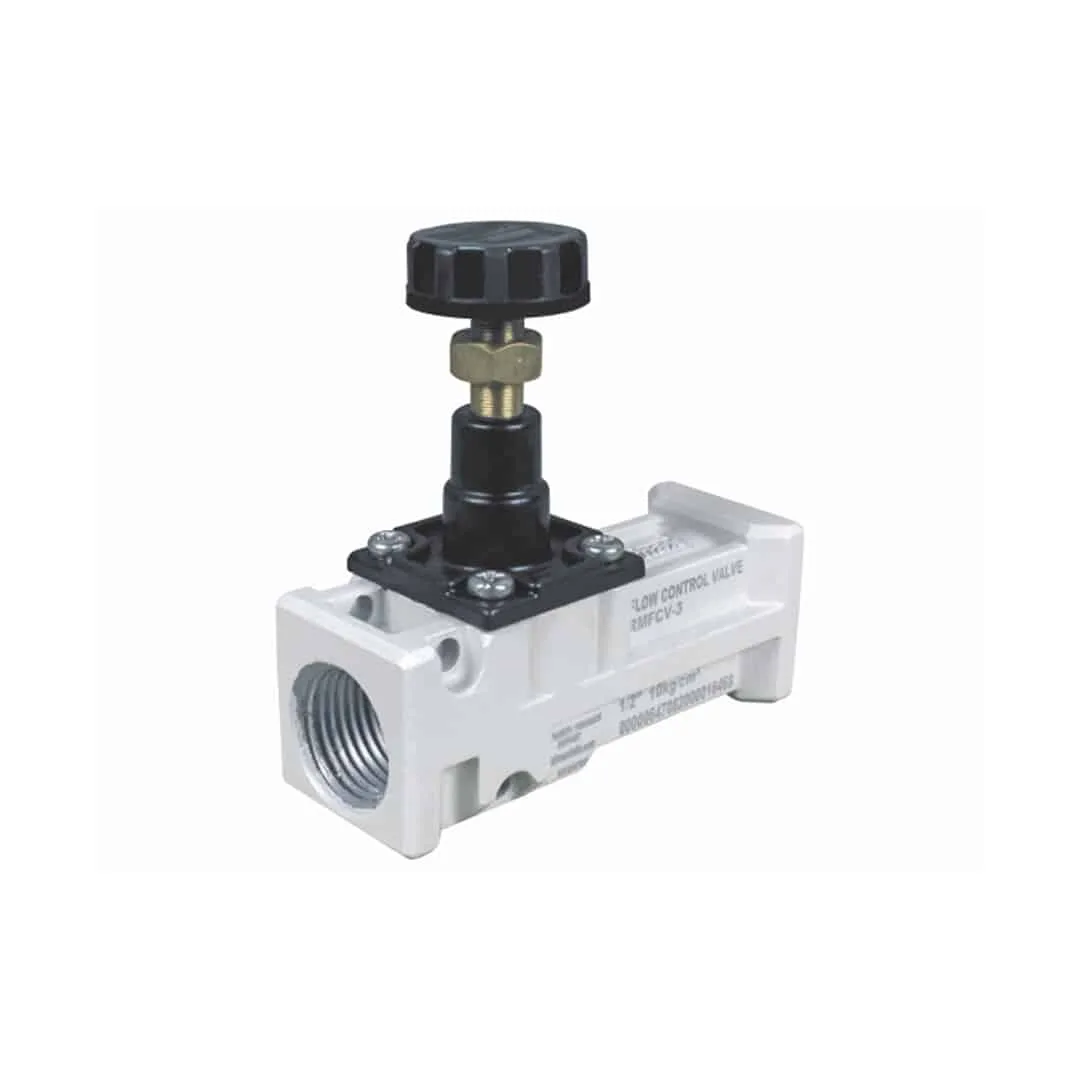
A one-way flow control valve sets how fast a pneumatic cylinder moves. A tapered needle in the flow path is advanced or withdrawn by the knob to restrict the passage; alongside it an internal check element lets air bypass the needle in the opposite direction. In the Airmax RMFCV, flow from port 1 to port 2 is free and flow from port 2 to port 1 is controlled, so the valve throttles the return path only and leaves the feed path unrestricted.
That asymmetry is the whole point. Fitting the valve to throttle air leaving the cylinder - meter-out - keeps the exhaust side of the piston under back pressure and gives smooth, controlled motion under load. Throttling the air entering the cylinder - meter-in - is only appropriate on light or well-guided loads, because with nothing holding the far side of the piston the rod tends to stick and lurch. The direction the valve is fitted therefore matters as much as how far the needle is opened, and the body carries a free-flow arrow so the orientation can be checked on site.
Bodies are aluminium pressure die cast with a zinc die-cast bonnet, brass needle pin and check nut, NBR O-rings, a stainless steel spring and polyacetal internals. The knob is nylon and is secured by a lock nut once the setting is found, so vibration does not drift the adjustment. Two through holes in the body take the valve onto a bracket or panel.
Size is chosen on flow rather than on pipe size alone: the range runs from 1050 NLPM at 5 bar in 1/4" to 9000 NLPM in 1", with the orifice widening from 6.5 mm to 25 mm across the range. Specify size, thread form, and which side of the cylinder the valve is to sit on. Air must be filtered and lubricated.