Description
A mechanical water meter measures volume with an element turned by the flow, geared to a mechanical register. Meters of this class are not specified by size alone. Under ISO 4064-1:2014 and OIML R 49-1:2013 a meter is designated by its permanent flow rate Q3 in cubic metres per hour together with the measuring ratio R = Q3/Q1, and both are marked on the dial - "Q3 2.5; R100" is a complete designation, "DN15" is not.
Four flow rates define the performance: the minimum Q1, the transitional Q2, the permanent Q3 and the overload Q4, with Q2/Q1 fixed at 1.6 and Q4/Q3 at 1.25. Between Q1 and Q2 a class 2 meter may err by ±5 % and a class 1 meter by ±3 %; between Q2 and Q4 the limits are ±2 % and ±1 % respectively for water from 0.1 to 30 °C, one percentage point wider above that. A meter carries no accuracy class marking when it is class 2 - the standard only requires the mark where the class differs.
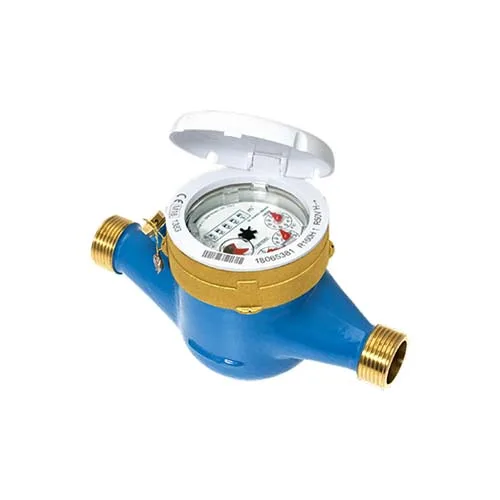
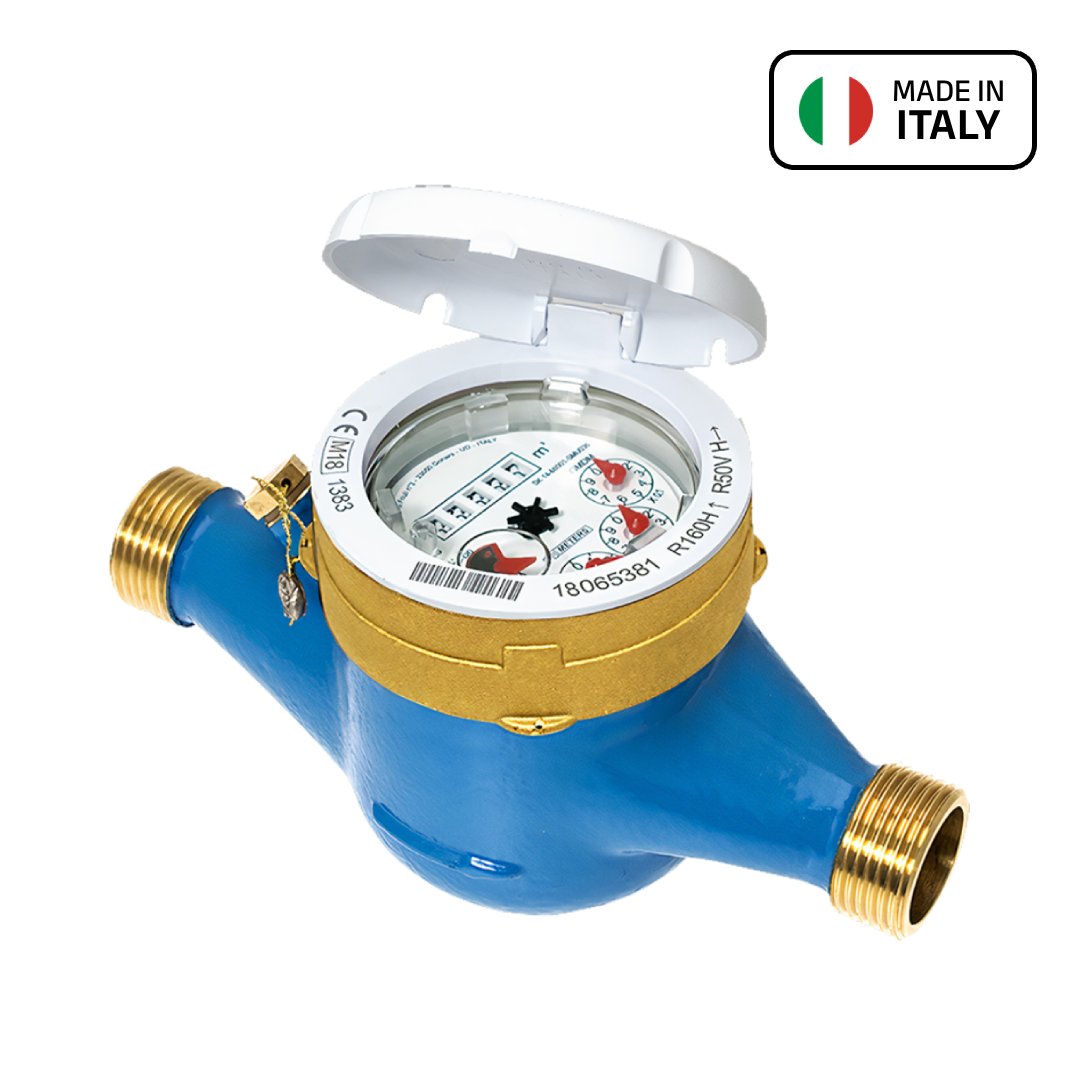
The unit photographed is marked R100 for horizontal installation and R50 for vertical. That is not a manufacturing variation but the standard's own provision for meters whose ratio depends on orientation, and it has a practical consequence: install one of these on its side or upright when it was marked for the other position and it loses half its measuring range at the low-flow end, which is exactly where under-registration goes unnoticed. Fit a strainer upstream where the supply carries sand or scale, and leave the straight lengths the type approval assumes.
When ordering, state Q3 and R, the connection size and thread form, the overall length between the tailpieces, the mounting orientation, the temperature class (T30 for cold water, T50 and above for hot), the pressure loss class, and whether a pulse output or remote reading is required. If the meter is for a billed or custody-transfer duty, ask which type approval it holds - that is a document, not a marking.