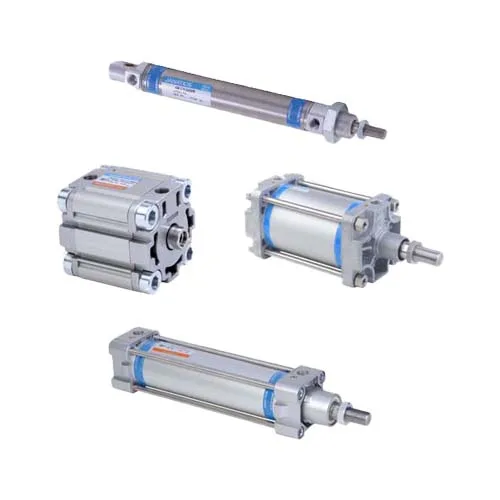
Description
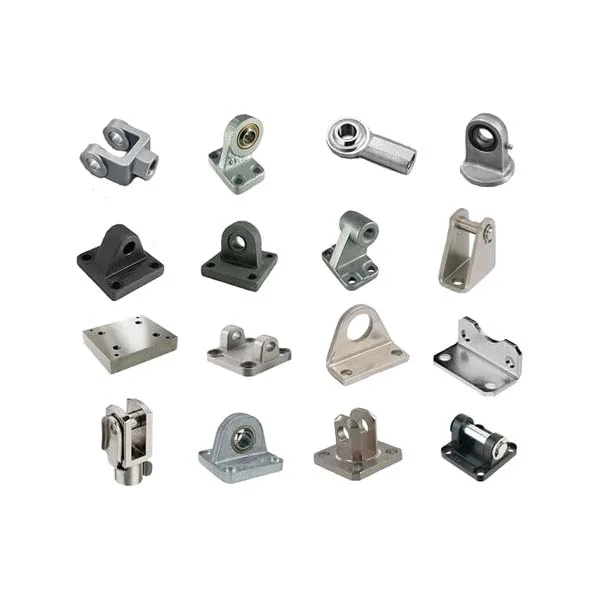
How a cylinder is fixed decides what happens to the loads it generates. A rigid mounting - foot bracket, front or rear flange - carries the reaction into the machine frame and suits a load that travels in a straight line held by its own guides. A pivoting mounting - rear clevis bracket, trunnion or swivel bracket - lets the cylinder swing as the load arcs, which is what a lever, a flap or a rotating arm needs. Getting this wrong is the usual cause of bent rods and worn rod bushes: a rigidly mounted cylinder driving a swinging load puts the whole side load through the rod seal.
The rod end is the other half of the decision. A rod clevis gives a single pivot axis and is the plain answer where the load moves in one plane. A rod-end spherical eye carries a spherical bearing and tolerates oscillating, tilting and slightly misaligned motion, which is what an installation that is not perfectly square actually needs. Both screw onto the piston rod thread and are secured by a lock nut.
These accessories are covered by their own ISO standards, so they interchange between makers. ISO 8139 fixes the mounting dimensions of rod-end spherical eyes and ISO 8140 those of rod-end clevises, and both are dimensioned for cylinders built to ISO 6432 and ISO 15552. The cylinder end mountings themselves come from ISO 15552 for bores of 32 mm to 320 mm and from ISO 6432 for bores of 8 mm to 25 mm.
When ordering, give the cylinder bore, the mounting style, and the piston rod thread - the rod thread is what the clevis or eye has to match and it is not implied by the bore alone. State also whether steel or stainless steel is wanted, since the standards fix dimensions but not material.