Description
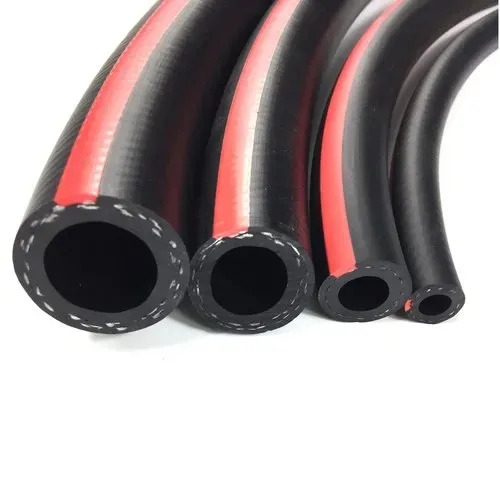
Textile-reinforced rubber air hose supplies compressed air to tools, hose reels, rigs and workshop ring mains. The construction is fixed by EN ISO 2398: a rubber lining, a reinforcement of natural or synthetic textile applied by any suitable technique, and a rubber cover, with lining and cover of uniform thickness, concentric, and free from holes and porosity. The cover finish may be smooth or fabric-marked.
The standard classifies air hose three ways at once, and all three belong on a purchase order. By pressure it is Type 1 (10 bar), Type 2 (16 bar) or Type 3 (25 bar) maximum working pressure. By oil resistance it is Class A (non-oil-resistant), Class B (normal oil resistance) or Class C (good oil resistance) - Class B or C is the choice wherever lubricated tools or oil carry-over from a compressor discharge are involved. By temperature it is Category N-T (-25 to +70 °C) or Category L-T (-40 to +70 °C).
Proof pressure is twice, and minimum burst pressure four times, the maximum working pressure: 20 and 40 bar for Type 1, 32 and 64 bar for Type 2, 50 and 100 bar for Type 3. Minimum lining and cover thicknesses rise with the type, from 1.0 and 1.5 mm on Type 1 to 2.0 and 2.5 mm on Type 3, and nominal inside diameters run from 4 to 102 mm.
State the bore, the length, and the required type, class and category, together with the coupling pattern. Compressed air is a stored-energy service: hose, couplings and clamps must be rated as a set, and whip restraints fitted wherever a hose or coupling failure could reach a person.