Description
A suction and delivery hose must resist collapse as well as pressure. A textile cord carcass carries the working pressure and an embedded steel helix keeps the bore open when the pump draws a vacuum. That helix is what separates a hardwall suction hose from a softwall delivery hose, which can only be used on the discharge side of a pump.
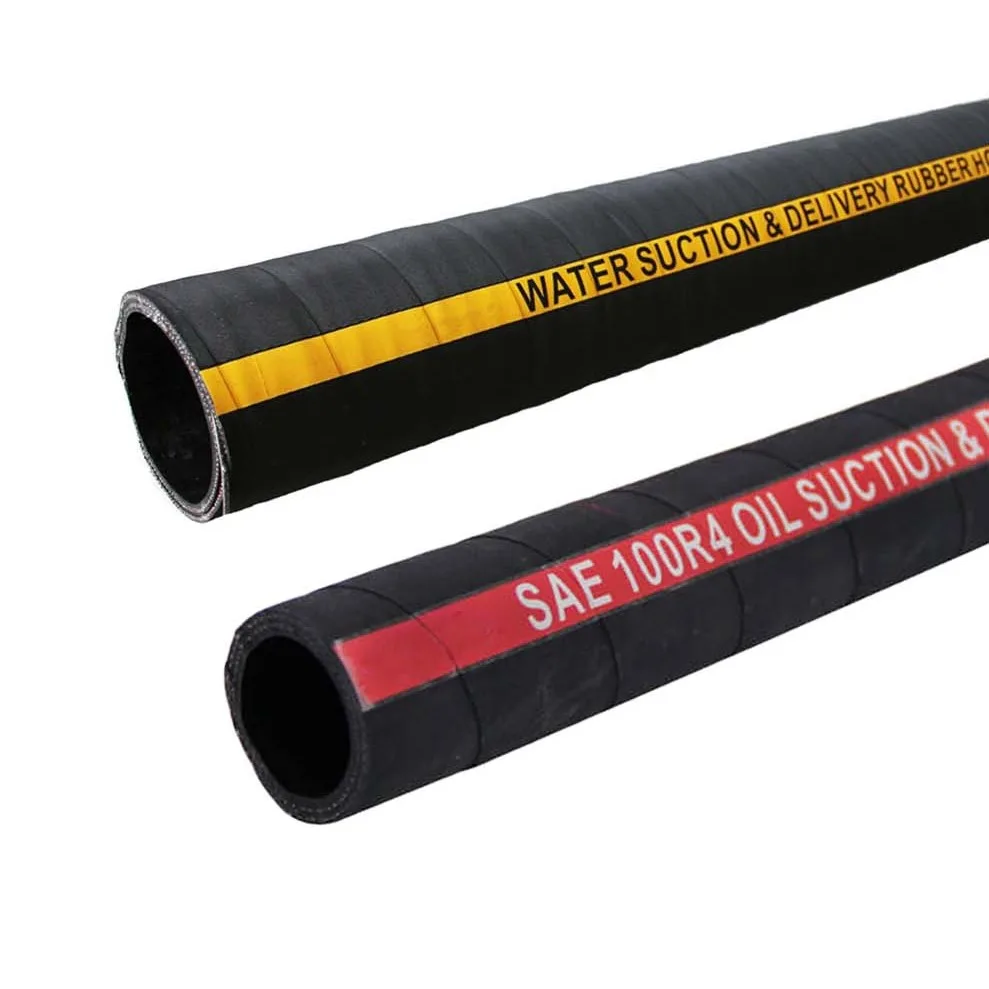
On the oil side IVG Colbachini publishes a range whose catalogue name is the standard it is built to: SAE 100 R4. The tube is black, smooth synthetic rubber, oil resistant except with ester-base fluids; reinforcement is high-strength synthetic cord plus steel helix wire; the cover is black, smooth wrapped-finish synthetic rubber, weathering resistant. It runs from 16 to 102 mm bore at 2.5 to 21 bar working pressure falling with bore, 0.9 bar vacuum at every size, a 4:1 burst ratio and up to 120 m continuous length. Tallin, Malmo and Ivalo cover the same duty at other pressure and temperature points; Malmo and Ivalo carry an NBR tube and take oils with aromatic content up to 30 %, again excluding ester-base fluids.
On the water side the equivalent hardwall range is Toronto: synthetic rubber tube, synthetic cord and helix wire, weathering- and ozone-resistant cover, 25 to 203 mm bore at 10 bar working and 30 bar burst, 0.9 bar vacuum, -30 to +70 °C. Amburgo is the corrugated-cover version for mud and sewage; Montreal and Oslo are softwall and lay-flat discharge hoses for lines where no suction duty is required.
State the medium, the bore, the length and the coupling pattern when ordering, and say separately whether suction duty is required, because a delivery-only hose will collapse in a suction line. This is not a chemical hose: acids, solvents and aggressive chemicals need an EPDM, EPR or PE-UHMW lined hose built and marked to EN 12115.