Description
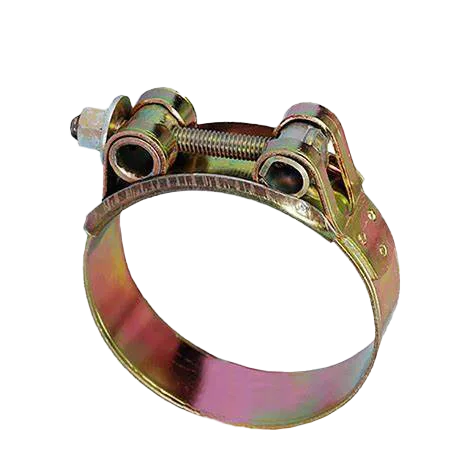
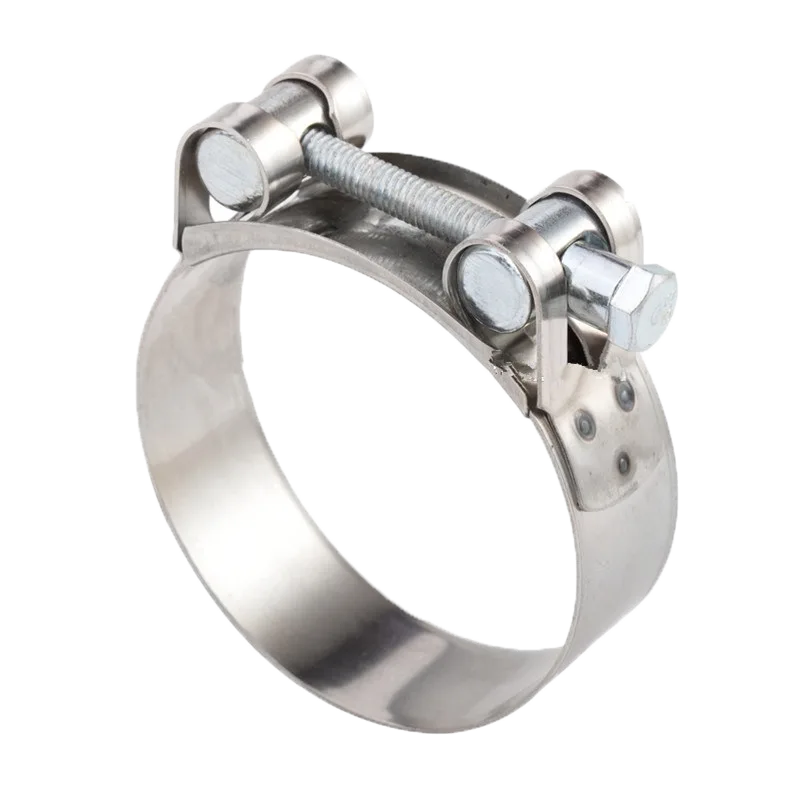
A T-bolt pattern clamp puts the whole clamping load on one bolt running through two trunnion rollers, so it can be tightened with an ordinary spanner and can be reached in places a worm drive screw cannot. The band edges are rolled so they do not cut the hose cover, and a bridge under the gap keeps the cover from being pinched into the opening. The gold colour that gives the clamp its trade name is a yellow passivate over zinc plating.
No DIN or ISO standard governs T-bolt clamps. They are a manufacturer pattern - Mikalor Supra, NORMA GBS and equivalents - so the clamping range, band width, bolt size and torque all come from the maker's own table rather than from a standard. As a reference, one European supplier lists an all-zinc-plated heavy duty clamp of this pattern in ranges from 17-19 mm up to 294-304 mm, with band widths of 18 to 26 mm and M5 to M10 bolts. It publishes no torque figure for that plated range; for its stainless Supra heavy duty pattern, which runs from 17-19 mm to 395-408 mm, maximum tightening torques run from 10 N m on an 18 mm band with an M6 bolt to 45 N m on a 28 mm band with an M10 bolt.
The same source gives a maximum medium pressure for the Supra pattern that falls with diameter, from 45 bar in the smallest sizes to 6 bar at 162-200 mm and 3 bar from 200-213 mm up to 395-408 mm, and qualifies it as depending on hose type and connection shape. Corrosion class matters as much as size: in the W1 to W5 classification used across this trade, W1 is zinc plated steel throughout - which is what this clamp is - while W4 and W5 are austenitic stainless.
State at order: hose outside diameter over the cover, the clamping range wanted, and the corrosion class.