Description
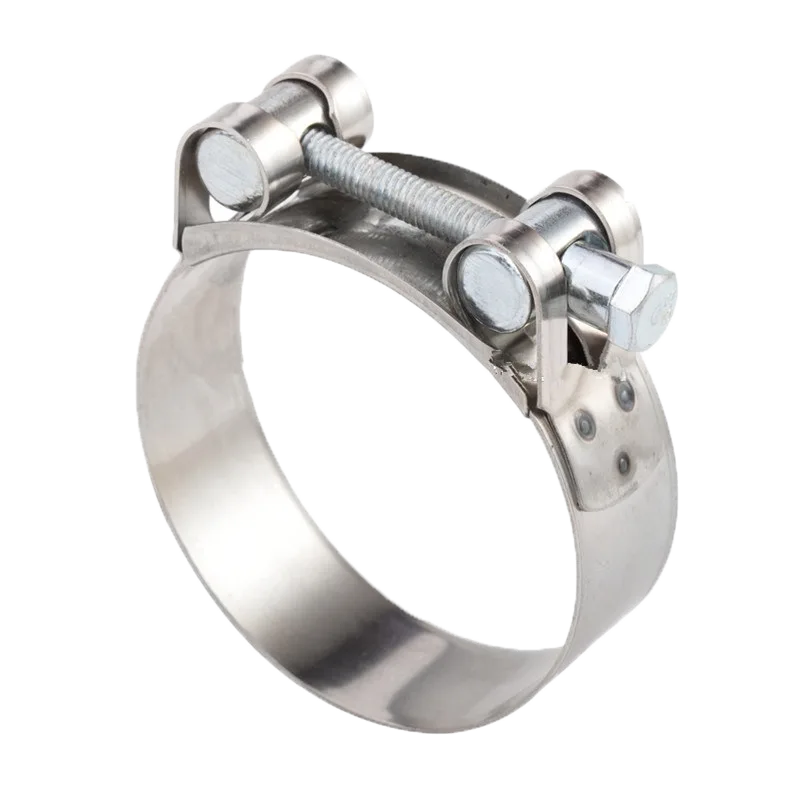
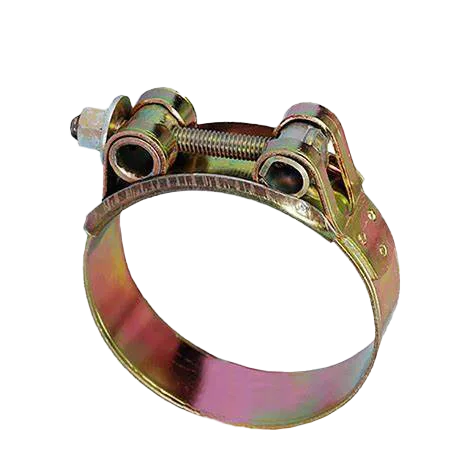
This is the same T-bolt pattern as the plated golden clamp, in stainless steel, for washdown areas, marine and coastal exposure, chemical service and anywhere a plated clamp would bloom with rust before the hose wears out. The band edges are rolled and a bridge spans the gap so the hose cover is not pinched.
The detail that decides how long it actually lasts is which parts are stainless. In the W1 to W5 classification used across this trade, W2 is a stainless band and bridge with a plated steel bolt and rollers, W4 is AISI 304 band and bridge with an AISI 302 bolt, and W5 is AISI 316 throughout. The clamp in the photograph has a stainless band and trunnions but a plated hex bolt, which is the W2 arrangement - and a plated bolt in a stainless clamp is the part that will corrode first. NORMA publishes minimum salt spray resistance of 72 h for W2, 400 h for W4 and 1000 h for W5.
No DIN or ISO standard governs the T-bolt clamp, so clamping range, band width, bolt size and torque come from the maker's own table. As a reference, one European supplier lists this pattern from 17-19 mm to 395-408 mm with band widths of 18, 20, 25 and 28 mm, M6 to M10 bolts, maximum tightening torques of 10 to 45 N m, and a maximum medium pressure falling from 45 bar in the small sizes to 6 bar at 162-200 mm and 3 bar above 200 mm, depending on hose type and connection shape.
State at order: hose outside diameter over the cover, clamping range and the corrosion class required - including whether the bolt must be stainless.