Description
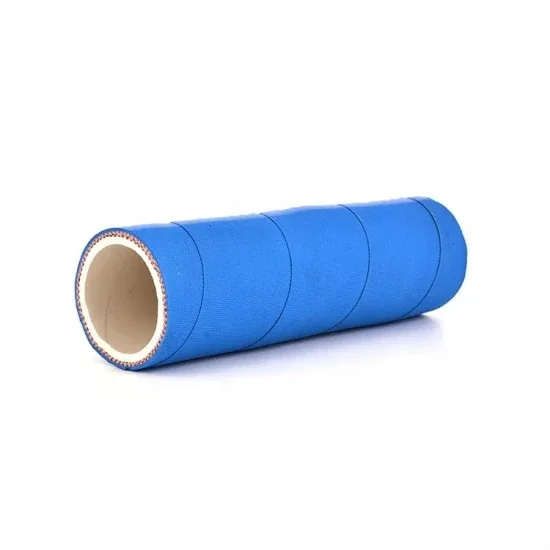
A suction and delivery hose has to do two opposite things: hold pressure on the delivery stroke and resist collapse under vacuum on the suction stroke. It manages the second with a wire helix embedded in the wall, which is what distinguishes it from a delivery-only hose and is why it can be run dry off a tanker or a sump without flattening.
The construction is a smooth, non-porous food-grade liner, a textile reinforcement carried around the helix, and a weather-resistant cover. The liner is the part that has to be matched to the product: a hose carrying fats, oils or dairy fat needs a liner compounded for it, and a liner chosen for water and non-fatty products will be leached and swollen by fat. State the medium explicitly at enquiry rather than describing it as food grade and leaving it there.
Food-contact compliance is a declaration, not an approval. Materials in contact with food fall under Regulation (EC) No 1935/2004, which requires that they transfer nothing into the food that endangers health, changes its composition unacceptably, or spoils its taste, smell or appearance. Rubber compounds are assessed against the permitted-substance list in 21 CFR 177.2600. Ask for the maker's declaration of conformity for the compound actually supplied.
State the bore, the length, the end fittings, the medium and the cleaning regime. Hose assemblies for food duty are normally fitted with stainless steel couplings of an appropriate internal finish, and the cleaning regime — steam, peracetic acid, phosphoric acid or caustic, and at what strength and temperature — should be given to the maker, because it is as likely to end the hose's life as the product is. The applicable 3-A standard for hose assemblies is 62-02.