Description
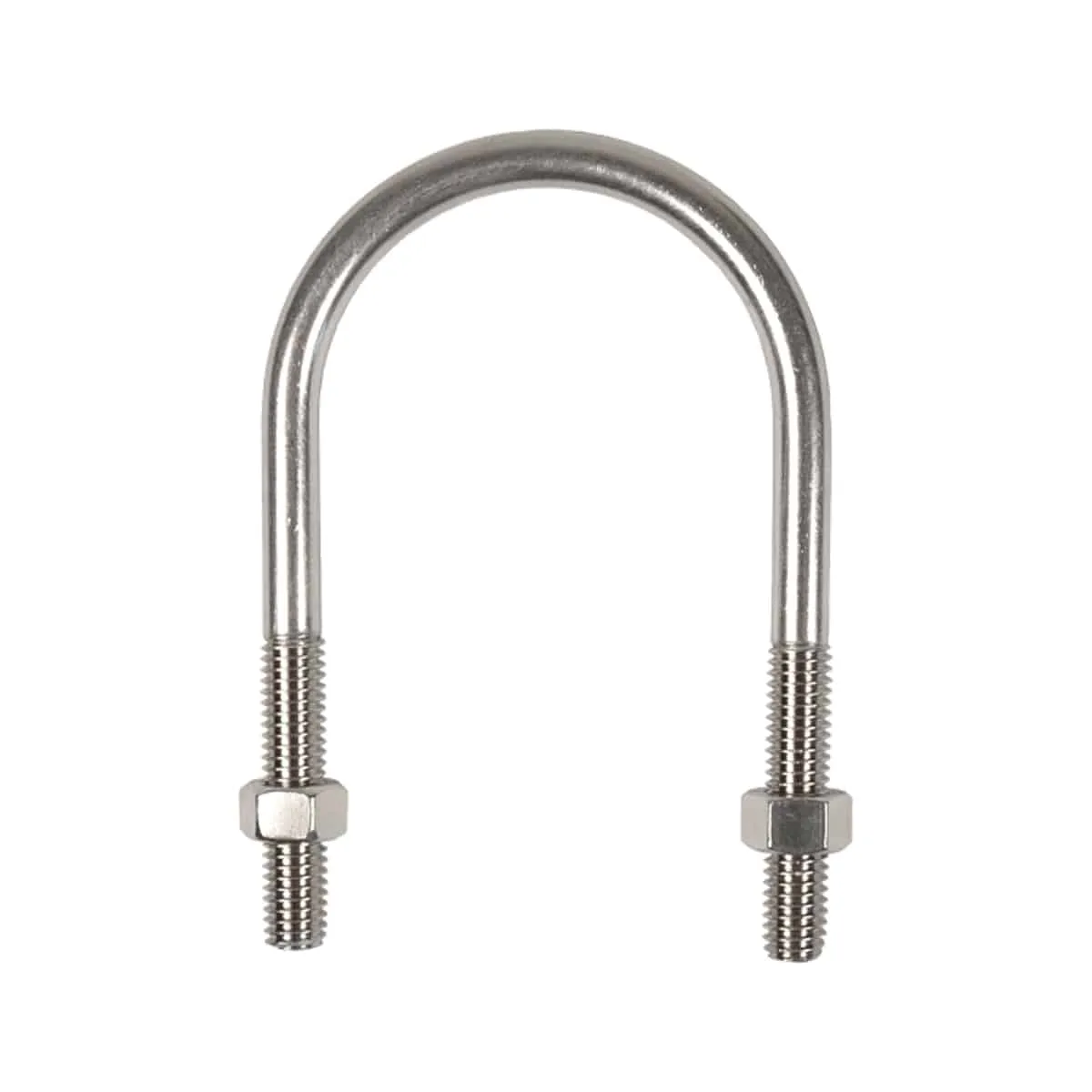
A U-bolt is a round bar bent into a U and threaded at both legs. Passed through two holes in a support angle, channel or plate and secured with a nut on each leg, it holds a pipe, a tube or a round bar against the support. It is the simplest and most widely used pipe fixing on plant, and it is the item photographed here: a stainless U-bolt with two hexagon nuts and no saddle.
DIN 3570 is the standard for round steel U-bolts of this kind. STAUFF, who make them to the standard, describe the assembly as one round steel U-bolt of type RBD to DIN 3570 Form A with two hexagon nuts to DIN EN ISO 4032, covering common pipe diameters between 25 and 521 mm. Materials offered are uncoated, galvanised or blue-chromatised steel, and stainless V4A 1.4401 / 1.4571, that is AISI 316 / 316Ti.
The size of a U-bolt is the outside diameter of the pipe it is to clamp, together with the thread size and the leg length; it is not a nominal bore. Ordering to bore instead of outside diameter is the usual cause of a U-bolt that will not close on the pipe. For lines that move or vibrate, a rubber-lined pipe clamp distributes the load better than bare metal on metal; a U-bolt clamps at two points and can indent thin-wall tube if it is over-tightened.
For outdoor and coastal work in Kuwait, specify the stainless option. ISO 3506-1 grade A4 - the 316 family with 2 to 3 % molybdenum - is what resists chloride pitting; grade A2 and plain zinc plating will not last in salt-laden air. When ordering, give the pipe outside diameter, the thread size, the material and the finish, and state whether nuts are required with the bolts.