Description
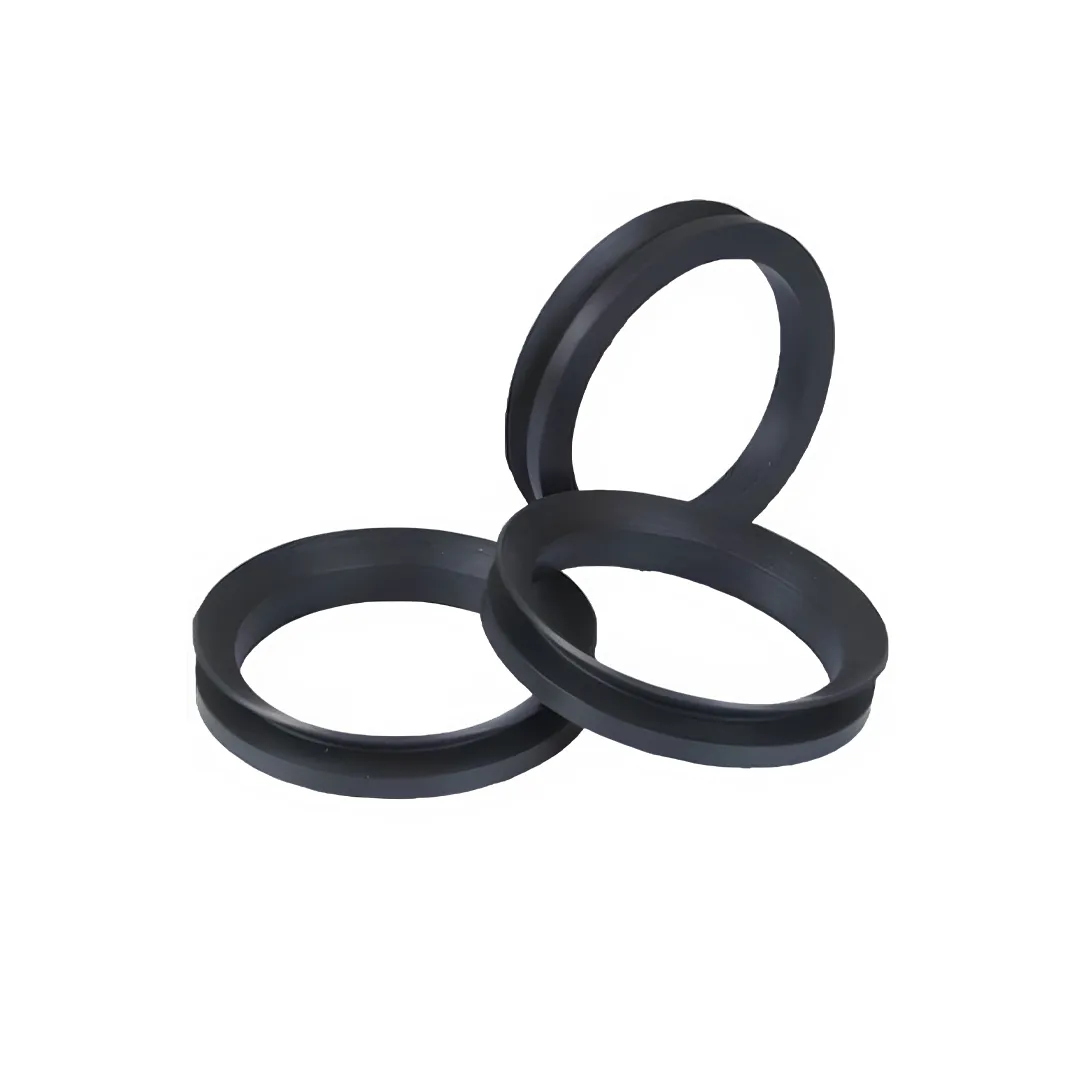
A V-ring is an all-rubber seal in three parts: a body that grips the shaft, a conical self-adjusting lip, and a hinge joining the two. It is fitted by hand directly onto the shaft, needs no housing bore and no shaft preparation, and rotates with the shaft while its lip bears axially against a stationary counterface - the end of a gearbox housing, a washer, a steel stamping, or the back of an oil seal.
Because the rubber body is very elastic - smaller sizes stretch to about two and a half times their free diameter - a V-ring can usually be fitted without dismantling the assembly, over flanges and pillow blocks. That, and its tolerance of shaft runout and misalignment, is why it is used as a secondary seal ahead of a bearing or a lip seal in dirty and wet environments.
Three profiles cover most work. The VR1, called VA in general trade use, is the most common style and the one available in the widest range of sizes, offered for shafts from 2,7 mm to 2020 mm. The VR2 (VS) has a wide body and tapered heel that holds it firmly on the shaft, for shafts from 4,5 mm to 210 mm. The VR3 (VL) has a very compact axial section for confined spaces where it replaces a labyrinth, for shafts from 105 mm upwards.
A V-ring is not a pressure seal. SKF's published data gives zero pressure as standard and up to about 0,7 bar only under particular conditions, so it must never be used to hold back a head of fluid. Above roughly 7,5 m/s surface speed a nitrile V-ring needs axial support, above 12 m/s it needs radial support as well, and at about 15 m/s the lip lifts off the counterface and the seal becomes a slinger. Order by profile letters and shaft diameter, and specify the counterface material and finish.