Description
Wire rope is built up from drawn steel wires laid into strands and the strands laid around a core. That construction is what gives the rope its combination of tensile strength and bending flexibility, and it is the first thing to specify: a rope of many fine wires bends more easily around a sheave, a rope of fewer, heavier wires resists abrasion better.
ISO 2408:2017 sets the requirements for the manufacture, testing, acceptance, packing, marking and certification of general purpose ropes. It covers round strand and compacted strand ropes with wires that are uncoated (bright), zinc-coated or Zn-Al coated. It expressly does not apply to ropes for mining, aircraft control, aerial ropeways and funiculars, or lifts - those are governed by their own standards, and a general purpose rope must not be substituted into them. Designation and classification follow ISO 17893, and minimum breaking forces are tabulated by class, grade and diameter in the standard's Annex D.
Rope grade is the strength label: grade 1570, 1770, 1960 or 2160, each corresponding to a range of wire tensile strength grades - grade 1770, for example, is built from wires in the 1570 to 1960 N/mm² range. The minimum breaking force for a rope is read from the table for its class, grade and nominal diameter; it is not calculated from the diameter alone and no single figure covers the range.
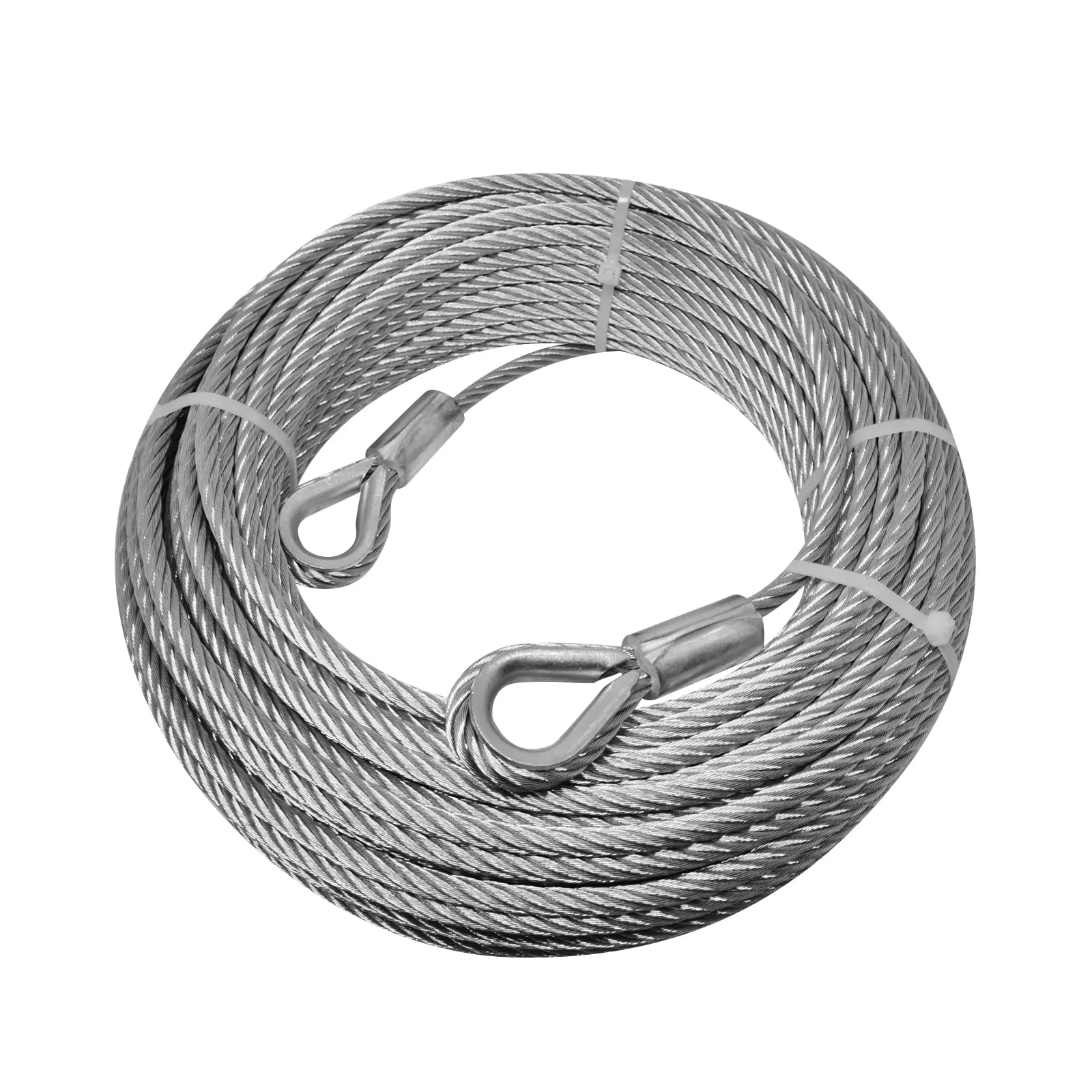
When ordering, state the nominal diameter, the construction class, the core - fibre or independent wire rope core - the rope grade, the wire finish, and the length. For made-up assemblies also give the end terminations: swaged ferrule and thimble eyes as photographed, or eyes formed with wire rope clips. Ask for the manufacturer's certificate; the minimum breaking force is on it.