Description
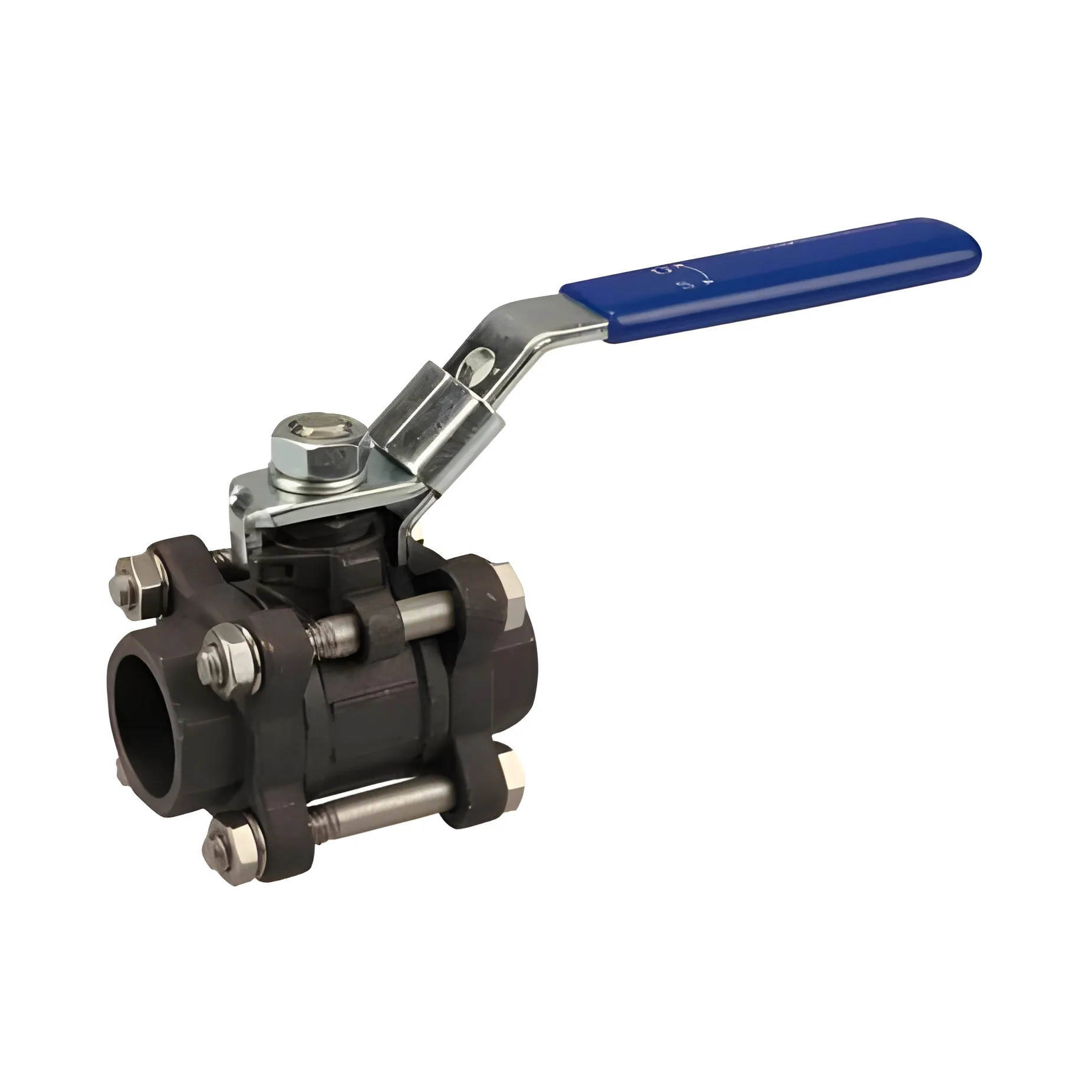
This is a socket weld ball valve on a three-piece body. The pipe enters a machined socket in each end cap and is fillet welded to it; the two end caps are then clamped to the centre section by four tie bolts. Because the welded joints are in the end caps and not in the centre section, slackening the four nuts lets the centre section, ball, seats and stem be withdrawn for servicing while the welded ends stay in the line.
Socket welding ends are specified for ball valves by ISO 17292:2015 (clause 5.2.4), which covers threaded and socket-welding end valves in sizes DN 8 to DN 50 (NPS 1/4 to 2). MSS SP-110, the standard practice for threaded, socket-welding, solder-joint, grooved and flared-end metal ball valves, covers NPS 1/4 to 4 and lists carbon steel among its body materials. Class 800 is the pressure designation ISO 17292:2015 reserves for threaded and socket-welding end valves; the other designations are Class 150, 300 and 600 and PN 16, 25, 40, 63 and 100.
The shell pressure/temperature rating is taken from ASME B16.34 for Class-designated valves or EN 12516-1 for PN-designated valves, and the valve rating is the lesser of the shell rating and the seat rating. On a soft-seated valve the seat, not the body, normally sets the temperature limit — ISO 17292:2015 fixes minimum seat pressure/temperature ratings for PTFE, modified PTFE, reinforced PTFE and reinforced modified PTFE.
On order state the nominal size and pipe schedule the sockets must accept, the pressure designation, the carbon steel grade, the seat material and any actuator mounting required. The socket weld joint is made to the applicable piping code, and the seats and seals must be removed from the valve before the ends are welded or they will be destroyed by the heat. Carbon steel is for non-corrosive service; specify stainless steel for chemical, potable water or marine duty.