Description
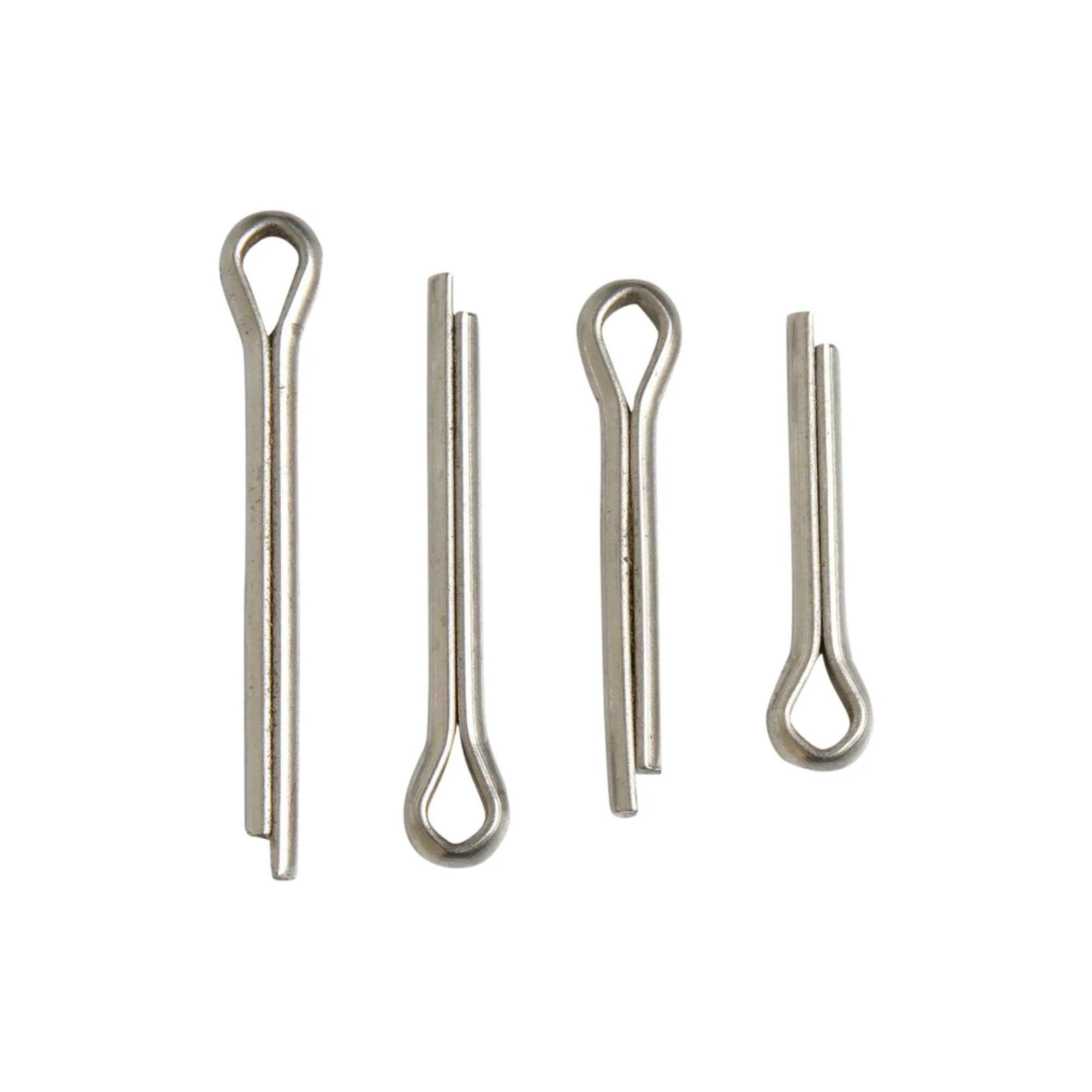
A split pin, also called a cotter pin, is a length of half-round wire folded to form an eye at one end and two prongs at the other. It is pushed through a cross-drilled hole and the prongs are bent back over the shaft or the nut face, so that nothing can back off. It is a positive mechanical lock, not a friction device, and it is the standard retention for castellated nuts, clevis and pivot pins, wheel hubs and shackle pins.
ISO 1234, which replaced DIN 94, specifies split pins in nominal diameters from 0,6 mm to 20 mm, in steel, in A2 and A4 stainless steel, and in brass and copper. The designation is nominal diameter by length. One prong is made slightly longer than the other so the pin can be started and opened easily.
The nominal size is chosen from the hole in the component, not from the bolt thread, and the length is chosen so that the prongs reach far enough to be bent fully back without leaving a long tail to snag. Stainless pins are used where the assembly is exposed to weather, washdown or seawater; A4 is the grade for chloride exposure.
Split pins are single-use items. A pin that has been opened, straightened and refitted has already been worked at the bend and should be replaced at every reassembly. When ordering, give the nominal diameter, the length and the material.