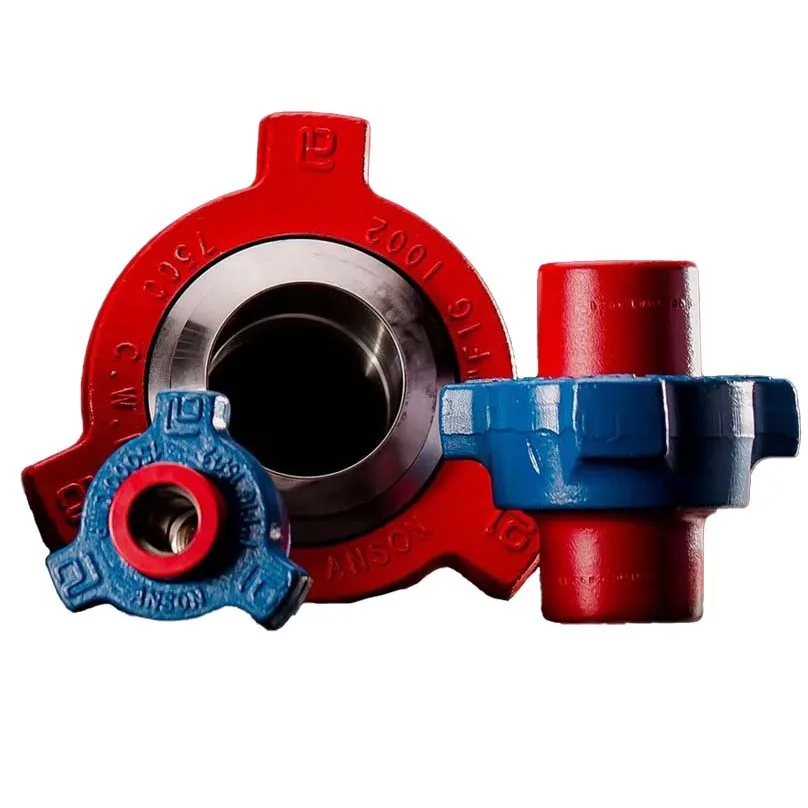
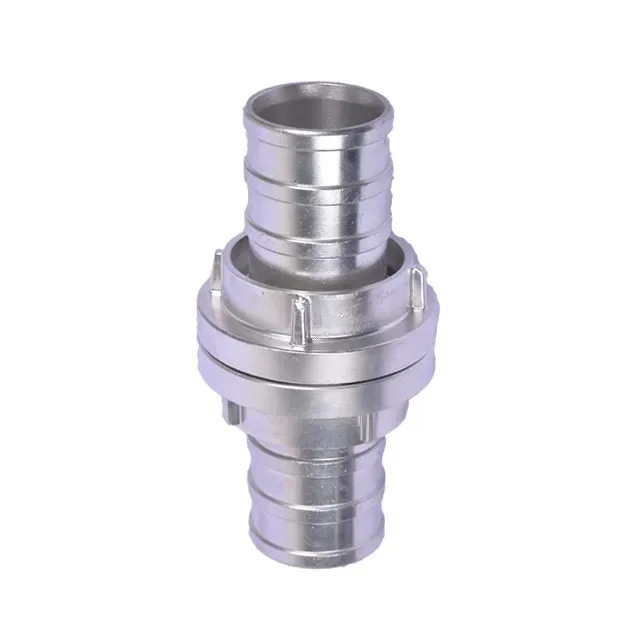
A hammer union is a three-piece screwed joint for high-pressure lines: a male sub, a female sub and a hammer-lug nut running on an ACME thread. The nut is struck with a hammer to pull the subs together, giving a joint that can be broken and remade repeatedly in the field without flanges or bolting. Line pipe threads and butt-weld ends are both standard.
The Figure number, not the size, fixes the pressure class. Parveen Industries publishes Fig 50 at 500 psi cold working pressure, Fig 100 at 1,000 psi, Fig 200 and Fig 206 at 2,000 psi, Fig 400 at 4,000 psi, Fig 600 and Fig 602 at 6,000 psi, Fig 1002, 1003 and 1004 at 10,000 psi, Fig 1502 at 15,000 psi and Fig 2002 at 20,000 psi, over sizes 1 to 12 inch. Two of those classes drop with size and the quick-reference table does not show it: Fig 400 is 2,500 psi from 5 to 8 inch, and Fig 1003 is 7,500 psi in 4 and 5 inch. Sour-service ratings are lower again: Fig 1002 drops to 7,500 psi and Fig 1502 to 10,000 psi. Sour-service unions built to NACE MR-01-75 and API RP-14E are painted olive green and stamped NACE.
Sealing changes with the class. Low-pressure figures seal metal to metal on the conical and spherical faces of the subs; medium-pressure figures add an O-ring on the male sub; high-pressure figures use a replaceable lip-type seal ring in the female sub, in Viton for sour service. Figures are also colour coded - Fig 200 and 206 blue nut with grey subs, Fig 400 black nut with red subs, Fig 602 black nut with orange subs, Fig 1002 red nut with blue subs, Fig 1502 blue nut with pink subs - but colour is a maker convention and must never be relied on by itself.
When ordering, state the Figure number, the nominal size, standard or sour service, and the end preparation. Subs and nuts of different Figures must never be mixed: several Figures share dimensions closely enough to assemble while carrying entirely different pressure ratings.