Description
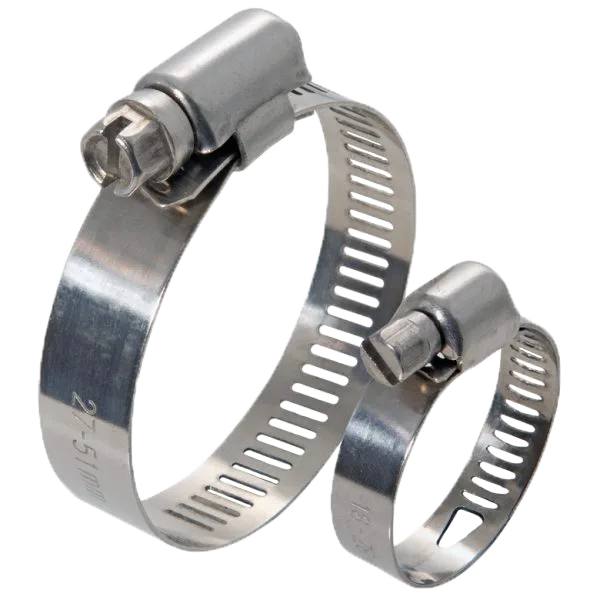
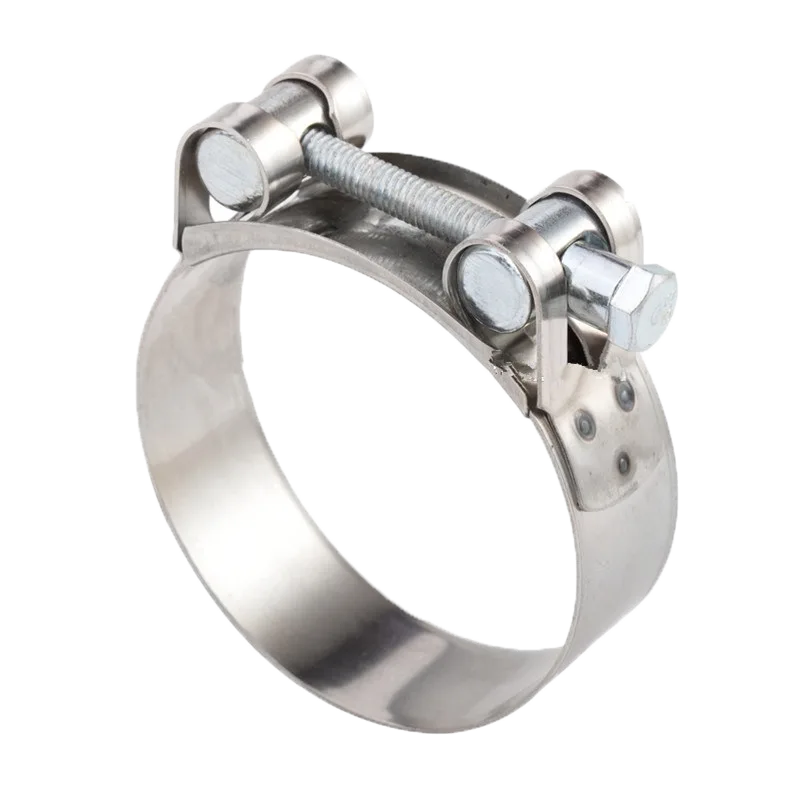
A worm drive clip is the general purpose hose clamp: a band, a housing and a screw whose thread engages slots or embossments in the band. Turning the screw draws the band down evenly. The photographed clips have a perforated (slotted) band, the American pattern, and the larger of the two is marked 27-51 mm.
Two conventions are on the market and they size differently. The American pattern follows SAE J1508 - Dixon states that its worm gear clamps meet SAE J1508, which supersedes Mil Spec WW-C-440B - and is listed by hose outside diameter with a 1/2 inch band; its size 24 covers 1-1/16 to 2 inch, which is the 27-51 mm marked on the clamp in the photograph. The German pattern follows DIN 3017-1, clamps with worm gear drive, shapes A and B, and is listed in clamping ranges from 8-16 mm up to 140-160 mm on a 9 mm band and up to 220-240 mm on a 12 mm band.
Torque is small and it matters. Published figures for DIN 3017 clamps are 3 to 4 N m on a 9 mm band and 4,2 to 6,8 N m on a 12 mm band; Dixon gives a maximum recommended 50 in lb, about 5,6 N m, for its worm gear clamps. Over-tightening cuts the hose cover; under-tightening lets the joint creep. Dixon states the point that is most often misread: torque ratings correspond to the torque rating of the screw of the clamp and are not an indication of the working pressure of any hose assembly installed with this clamp.
Pressure capability comes from the hose and the joint, and it falls as diameter rises: one supplier rates DIN 3017 9 mm band clamps at 45 bar maximum medium pressure in the 8-16 mm size and 5 bar at 140-160 mm, depending on hose type and connection shape. State at order: clamping range, band width and corrosion class - and whether the screw as well as the band must be stainless.