Description
A dispensing hose is twisted every time it is dragged round a vehicle and coiled back onto the hook. Without a swivel that twist is absorbed by the hose itself, which shortens its life at the crimped ends, and by the threaded joints, which work loose. A swivel takes the rotation on a bearing surface sealed by an O-ring, so the two halves turn freely against each other while the joint stays tight.
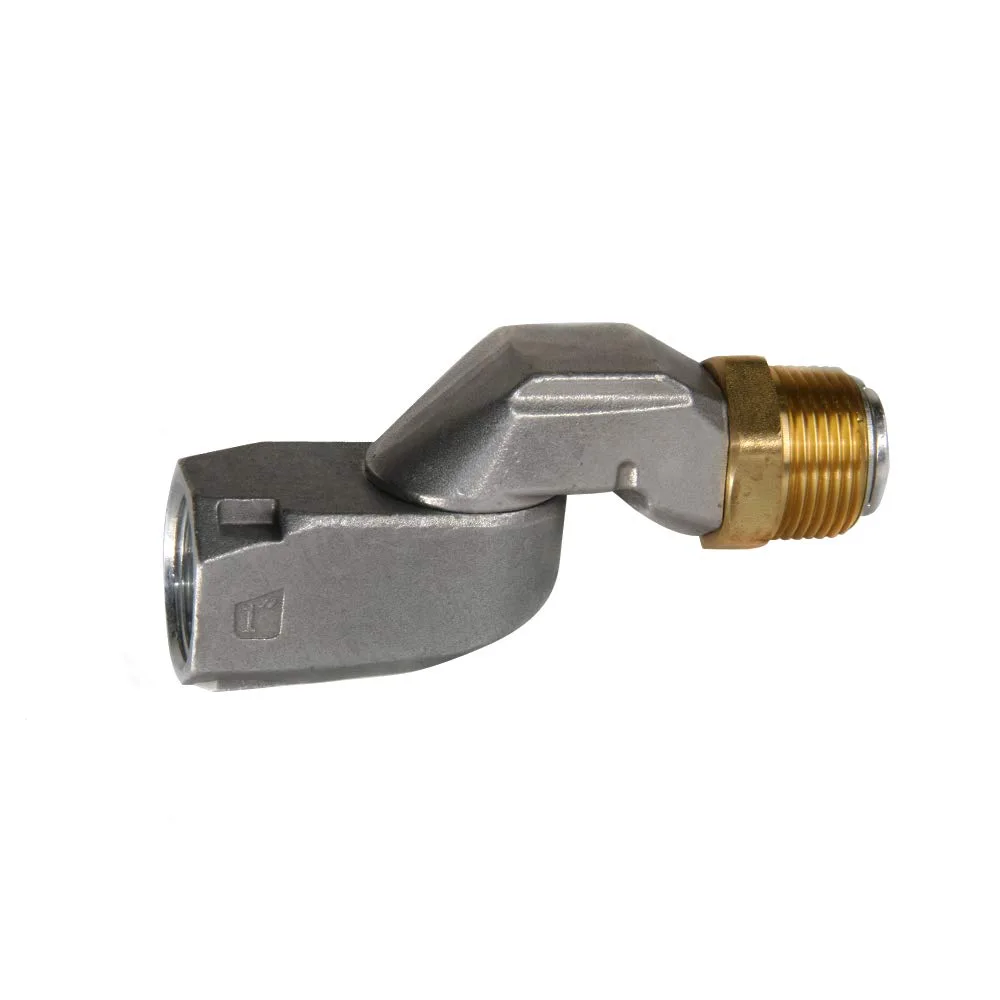
The item photographed has a male thread at one end and a female thread at the other, the usual arrangement for fitting between the hose tail and the nozzle inlet. It carries two rotating joints, not one: a knuckle between the two body castings as well as the rotating union at the male end, which is the two-plane arrangement used on heavy or high-hanging hose installations. Single-plane swivels, with rotation about one axis only, are also made.
EN 13617-4, Petrol filling stations — Part 4: Safety requirements for construction and performance of swivels for use on metering pumps and dispensers, is the European standard that governs this class of fitting. The EN 13617 series applies to equipment at filling stations dispensing liquid fuels and aqueous urea solution into motor vehicles, boats, light aircraft and portable containers, at flow rates up to 200 l/min.
When ordering, state both thread sizes and forms, whether the fuel is petrol, diesel or AdBlue (the seal elastomer follows from this), and whether the installation needs a single-plane or a two-plane swivel. Neither thread nor elastomer can be read from the photograph, and both decide whether the part fits.