Description
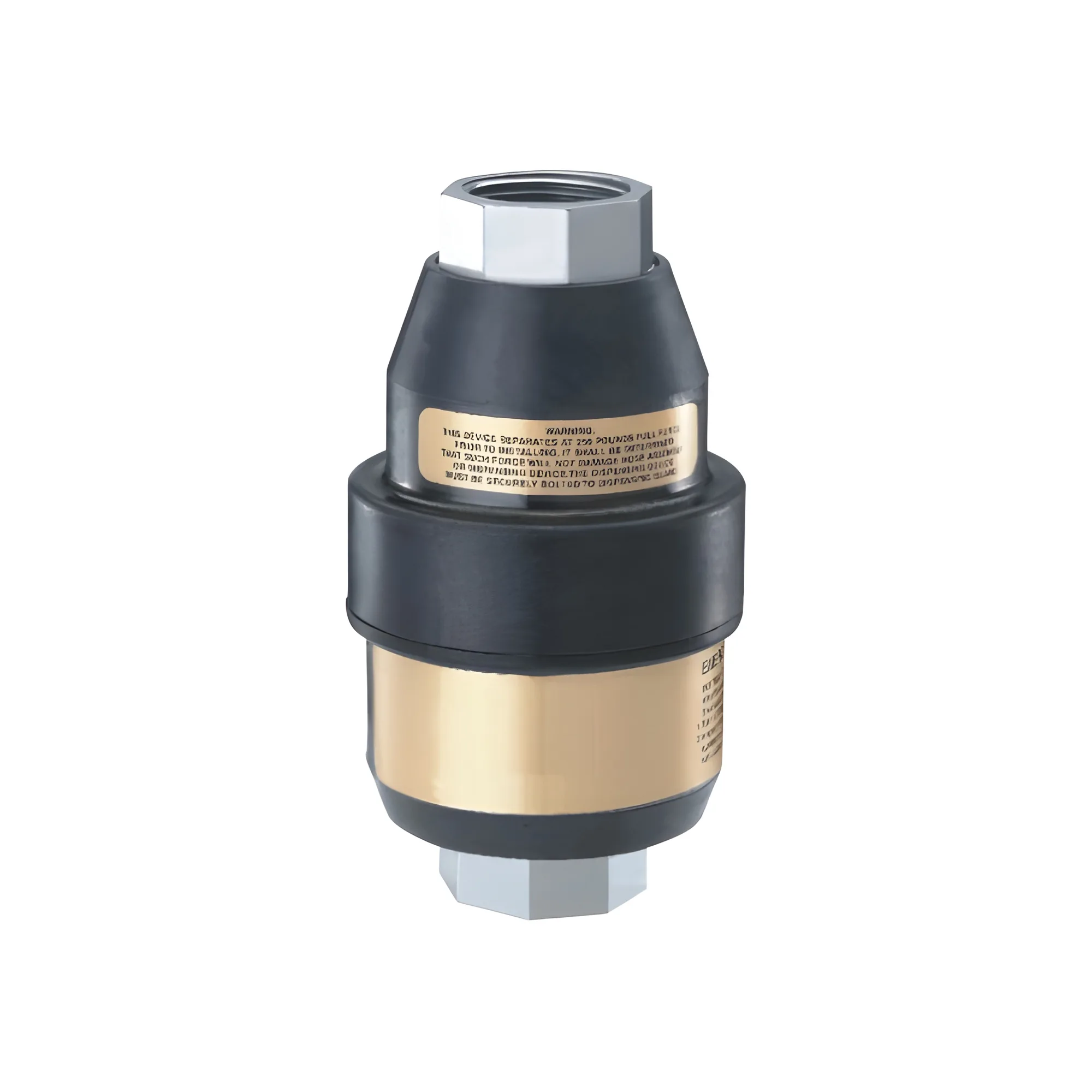
The commonest serious incident on a forecourt is a driver pulling away with the nozzle still in the filler. A breakaway coupling is the fitting that makes that survivable: it is the deliberate weak point in the hose assembly, calibrated to separate before the hose, the swivel or the dispenser itself can be torn apart.
The U405 is published in two separation forces, 250 lb ±5 % (about 1 112 N) and 300 lb ±5 % (about 1 334 N); which one a given coupling is set to must be confirmed against the plate on the item itself. Dual valves seat automatically as the halves part, so both the dispenser side and the nozzle side close and spillage is limited to the fuel already past the break. A reconnectable breakaway is designed to be put back into service rather than replaced: the halves are pushed together and twisted until an audible click confirms correct reconnection, which takes roughly 15 lb (about 67 N) of force. The seal lands on an O-ring before the poppet stems engage, so the joint is tight before flow can pass.
Construction is a die-cast zinc body with Viton main seals, a stainless steel main spring, and POM guide and poppet. Rated flow is 0 to 60 l/min at a working pressure of 0.18 MPa (1.8 bar). On high-hanging hose installations the manufacturer requires a straightening hose of at least 12" (305 mm) for the breakaway to work properly.
EN 13617-2, Petrol filling stations — Part 2: Safety requirements for construction and performance of safe breaks for use on metering pumps and dispensers, is the European standard governing this class of fitting. Before installing, verify that the separation force cannot overturn the dispenser: the warning plate on the item requires the dispenser to be securely bolted to the concrete island.